
AI news ·
Gates Foundation pledges $1 billion to bring AI to health care, agriculture, and education in low-income countries
The Gates Foundation is committing $1 billion to bring AI tools to health care, education, and agriculture in low-income nations. Roughly $400 million will target health care and another $400 million education, with the foundation warning the next 12 to 18 months will decide whether AI narrows or...
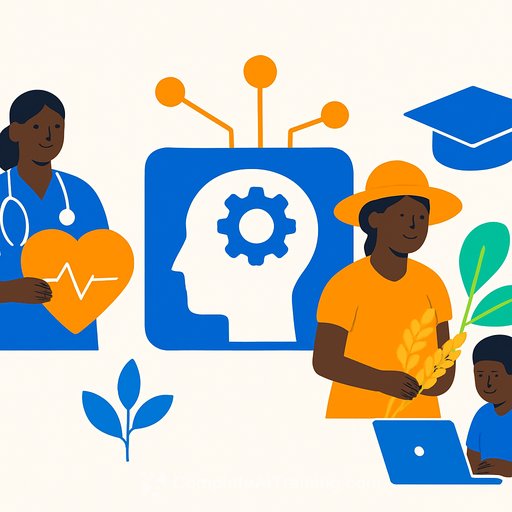
The Gates Foundation committed $1 billion over the next two years to bring artificial intelligence tools into health care, education, and agriculture in low-income communities - populations that current AI development has largely ignored. The pledge, announced Tuesday alongside the foundation's annual Goalkeepers report, comes with a blunt warning: the next 12 to 18 months will determine whether AI narrows or widens the gap between wealthy and poor nations.
Roughly $400 million of the funding will go toward health care, another $400 million toward education, and about $100 million toward agriculture, the Associated Press reported. An additional $100 million will fund the creation of AI training data sets in languages spoken by underserved communities, addressing a core technical barrier that makes existing AI systems far less useful for millions of people.
AI companies join the push
Gates Foundation CEO Mark Suzman said the foundation is coordinating with leading AI companies on the initiative. Google.org and Microsoft's AI for Good Lab are backing an open call for proposals to strengthen language infrastructure for communities across Africa whose languages are poorly represented in current AI models. OpenAI is contributing $50 million to a pilot program that puts AI tools directly into the hands of health workers at Rwandan clinics, with plans to expand to additional African countries. Anthropic's collaboration includes efforts to speed up vaccine research and build the AI's knowledge of locally grown crops.
Bill Gates, the foundation's chairman, described the investment as a response to a fundamental market failure. The Goalkeepers report warned that without deliberate intervention, "the most capable tools will be built first for the people and institutions most able to pay for them."
The scale of the gap
The report cited stark numbers. In sub-Saharan Africa, one doctor serves roughly 2,000 people, compared with fewer than 200 per doctor in high-income countries. AI speech recognition systems produce errors more than 60% of the time in Yoruba, versus less than 6% in English. These are not small discrepancies - they are structural failures that determine who gets accurate medical advice, who can use voice-powered learning tools, and whose crops get diagnosed by computer vision.
Suzman acknowledged that the foundation's total commitment is a "tiny proportion" of what major technology companies spend on commercial AI products. Conversations with those companies about additional contributions are continuing.
Timing and broader governance push
The Goalkeepers report arrives just before the United Nations General Assembly convenes high-level meetings in New York next week. U.N. Secretary-General António Guterres has pushed for developing countries to have a seat at the table as global AI governance frameworks take shape. The foundation and Anthropic also announced a $200 million partnership earlier this year to deploy AI across global health, education, and economic mobility programs, with Anthropic contributing Claude AI usage credits and technical staff support.
Why this matters for educators
The $400 million earmarked for education signals that large-scale AI deployments in classrooms and learning systems are coming to communities that have been largely excluded from the current wave of AI tools. For teachers and education professionals, this means the next generation of AI in schools may not look like the premium subscription products marketed in wealthy districts. It will need to work with limited connectivity, in multiple languages, and with training data that reflects local curricula and cultural contexts. Educators who understand AI for Education in these constrained environments will be positioned to shape how those tools get used - rather than having them imposed from outside. For teachers looking to build those skills now, resources like AI for Teachers offer practical starting points that apply regardless of the technology budget.