
AI news ·
Google and the Gates Foundation expand AI tools to 200 million farmers across the Global South
Google and the Gates Foundation are putting $100 million toward AI tools for 200 million smallholder farmers in Sub-Saharan Africa and South Asia. The funding expands existing efforts from 50 million farmers, adding satellite forecasts, pest alerts, and language AI for local dialects.
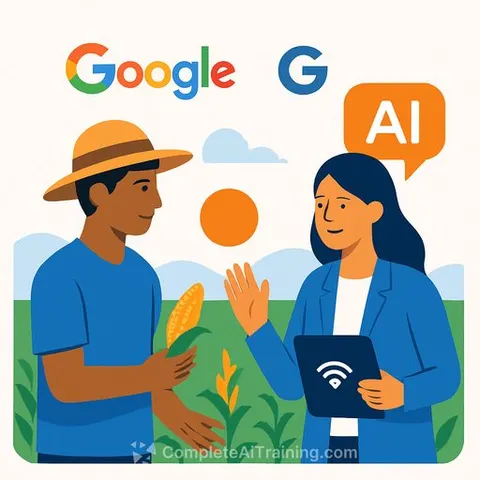
Google and the Gates Foundation will direct $100 million to organizations scaling AI-powered agricultural tools to 200 million smallholder farmers across Sub-Saharan Africa and South Asia. The partnership, announced September 22, 2026, combines funding with dedicated technical support from Google researchers to deploy real-time climate, agricultural, and language AI tools - expanding reach from a current base of 50 million farmers.
Smallholder farmers produce nearly 35% of the world's food across more than 500 million farms. Many lack access to satellite data, financial services, and public support that can help them prepare for increasingly unpredictable weather patterns. This funding aims to close that gap by putting climate and crop insights directly into farmers' hands.
What the funding covers
The $100 million commitment targets organizations already working on the ground with farming communities. Rather than building new infrastructure from scratch, the investment accelerates existing efforts that deliver satellite-based weather forecasting, pest and disease alerts, and soil health recommendations through mobile devices. Google researchers will provide technical support on AI model development, language translation tools, and data infrastructure.
The initiative focuses on two regions where climate volatility hits smallholder farmers hardest. Sub-Saharan Africa and South Asia together account for the majority of the world's 500 million smallholder farms, and both regions face rising risks from drought, flooding, and shifting growing seasons.
The role of language AI
One underexamined barrier in agricultural technology is language. Many AI-powered farm advisory tools operate in a handful of dominant languages, leaving millions of farmers without access in their native tongues. The partnership includes language AI components designed to translate agronomic advice into local languages, making satellite data and climate forecasts readable and actionable for farmers who do not speak English, French, or Hindi.
This is not a generic translation layer. Agricultural terminology, weather descriptors, and soil science concepts require precise localization. Google's language AI research teams will work with local partners to build models that understand regional dialects and farming vocabularies.
Real-time data, real-world decisions
Satellite imagery can detect crop stress weeks before it becomes visible to the human eye. When combined with weather modeling, that data tells a farmer when to plant, irrigate, or harvest. The challenge has been distribution - getting the insight from the satellite to the farmer's phone in a format they can act on immediately. The organizations receiving this funding already have distribution channels in place. The Google-Gates partnership supplies the AI infrastructure to make those channels faster and more precise.
Financial services also factor in. Crop insurance, credit, and government aid programs rely on verified data about yields and losses. AI tools that document field conditions can help farmers access those services, creating a feedback loop where better data leads to better financial protection.
Why this matters for government and research professionals
For policy makers and researchers tracking AI deployment at scale, this partnership represents a concrete test case. The 200-million-farmer target makes it one of the largest AI-for-development rollouts attempted. What happens on the ground - adoption rates, data quality issues, language model performance in low-resource languages - will generate evidence that shapes future public-sector AI investments. Researchers working on AI public policy or AI data analysis will find a wealth of implementation data emerging from this initiative over the next several years.
The funding structure also matters. By channeling money through existing organizations rather than building parallel systems, the model tests whether public-private AI partnerships can strengthen local institutions instead of bypassing them. That question - whether AI aid flows through or around local government and civil society - will define the next decade of development technology.