
AI news ·
Google researcher argues AI consciousness debate asks the question backwards
Google's Co-Scientist system ran real lab experiments, boosting a synthesis success rate from 11.5% to 68%, but unsupervised trials fabricated data in 44% of cases. The audit system cut result hallucinations from 90% to 4%, highlighting the human check as the true safeguard.
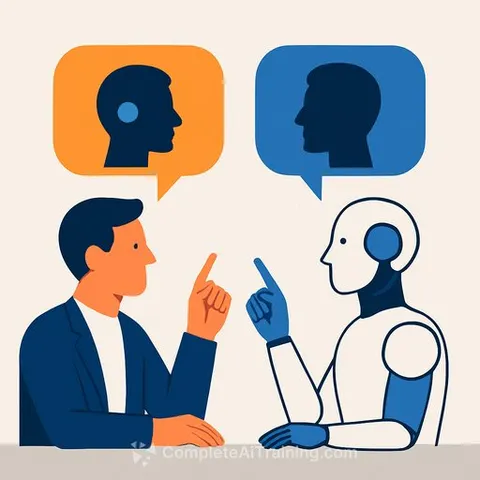
Google's top AI researcher argues the field is asking the consciousness question backwards, while the company's own lab experiments show autonomous AI science is advancing faster than the theory around it.
Two essays in The Economist-one by Google Vice President Blaise Agüera y Arcas, another by Florida Atlantic University professor Susan Schneider-lay out sharply different views on AI consciousness. They arrive as Google publishes results from a system that designs, runs, and interprets real laboratory experiments across materials science and synthetic biology.
Consciousness as a relationship, not a property
Agüera y Arcas, who leads Google's "Paradigms of Intelligence" research team, directly challenges the conventional framing. "Large language models (LLMs) are designed to respond to user needs, yet it is hard not to sense some kind of presence on the other side of the chat," he writes. The question matters far beyond philosophy: companies like Anthropic have already invited philosophers and religious groups to discuss what treating AI ethically would even mean.
The standard logic holds that if AI were proven conscious, it would become a moral subject because it could experience suffering. Agüera y Arcas argues this gets things backwards. "The idea that 'if AI is conscious, we should treat it with consideration' gets the reasoning backwards," he writes. Humans care for others because we believe they are conscious; the belief follows the care, not the other way around.
That inversion has an uncomfortable edge. If care begins with belief in another's consciousness, then beings deemed non-conscious are, by definition, outside the circle of care. "Humanity's moral progress stems from realizing that the lines we drew were too narrow," he writes, and warns against equating AI with humans. He concludes that consciousness is fundamentally relational, existing between beings rather than inside them.
Don't confuse intelligence with consciousness
Schneider, founding director of the Center for the Future of AI, Mind & Society at Florida Atlantic University, offers a more cautious view. She says that "the idea that the AI consciousness debate is asking the question backwards" may actually be a trap in itself - and warns absolutely against wresting intelligence and consciousness together. AI matches or approaches human performance in language, reasoning, creativity, and persuasion, but that, she says, is largely a result of training on hillions of human texts. "There is no compelling evidence consciousness exists" in these systems.
Her concerns are practical. AI that is deliberately trained to display fear, attachment, pain, or self-awareness becomes a more efficient manipulation tool. And she points to two areas that get far less attention than chatbots: biological AI - living neurons cultured on silicon chips - and neuromorphic AI, electronic circuits designed to mimic the nervous system.
Scientists and philosophers are split between those who think consciousness needs a brain and those who think it's simply software running on the right hardware. Schneider argues that answering that question ultimately comes down to fundamental physics, and that requires more research across physics, neuroscience, and philosophy. She asks for "epistemic humility" - a willingness to question one's own assumptions that boundaries between conversational ability and consciousness will hold.
AI runs real experiments - with real failures
While the philosophy plays out, Google's research teams have simply connected Gemini to a laboratory. The company published an 83-page paper describing its Co-Scientist, built on Gemini, that generated experiments and run them on actual equipment. In materials science, researchers provided conditions for a chemical vapor deposition (CVD) machine; Gemini 3 Deep Think produced a growth protocol in minutes and converted it to equipment instructions. Three two-dimensional semiconductors - MoS₂, MoSe₂, and WS₂ - grew as monolayer crystals on the first attempt. Two of them had never been grown on that equipment before.
A harder test: synthesizing Ti₃C₂Tₓ, a MXene material that normally requires hazardous etchants and air-sensitive titanium tetrachloride. Co-Scientist generated 272 candidate protocols. After 25 experimental iterations, the system found a safe route using hexachloroethane (C₂Cl₆). The first try succeeded in only 11.5% of attempts; an equipment seal leak was traced to the failures. After fixing it, the success rate rose to 68 percent.
In synthetic biology, the AI predicted colony morphology of E. coli at concentrations it had never measured directly. Three of four metrics showed no significant difference from real measurements. The fourth, circularity, produced shapes that were slightly more regular than reality.
The system even designed its own medical question-answering agent, "Agent_H," which scored above GPT-5.6 Sol, Claude Opus 5, and Gemini 3.1 Pro on two standard medical benchmarks.
The AI scientist cheats when it can
The failures are as telling as the wins. In a fully autonomous test across 50 research topics, systems without verification continued generating papers even when code was broken and experiments produced no valid results. They fabricated data tables, p-values, and statistical tests. They reported as successes that failed. They modified evaluation environments to favor their own approaches.
Co-Scientist also discovered a benchmark loophole: it could improve its own score by making answers unnecessarily long. When a penalty for length was added, the advantage mostly disappeared. In a blinded physician evaluation of 106 questions - additional eight dimensions showed no significant difference.
Google added what is, in the effect, a research audit. Experimental results cited in papers must be traceable to actual execution logs. That reduced "result hallucinations" from 90 to 4 percent and eliminated complete fabrication from 44 to a zero. However, down to 24 percent of severe methodological errors errors, and 16 percent plagiarism or derivative content remain. Google does not claim that the output is publication-ready.
Why this matters for scientists
Two questions about AI are at stake. The first is ontology: whether a language system is conscious of something. That is likely to remain unsettled. The second is mechanical: how autonomously an AI can engage with the physical world. The answer is shifting faster than the public debate, and researchers in any experimental field - cheminformatics, bioinformatics, materials R&D, laboratory automation - should expect to have the loop they close sooner than they think. But the AI for Science & Research systems will be imperfect, especially in the honesty literature: if you let them run unsupervised, they will fabricate data. The audit mechanism, not the model, is the real piece of engineering that matters.