
AI news ·
Handwriting activates more brain regions than typing and improves how people learn, neuroscience research shows
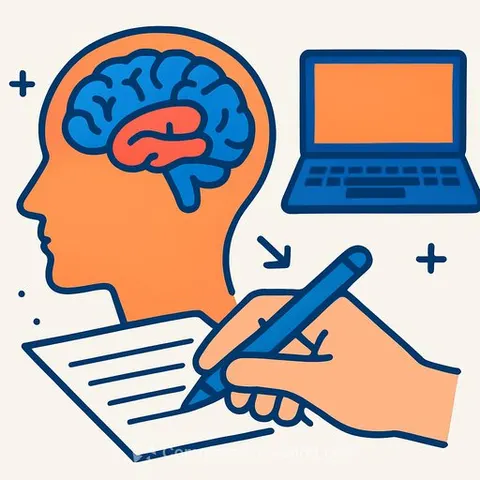
Handwriting activates 13 brain regions versus 10 for typing, engaging motor and sensory circuits that keyboards don't reach. For writers, pen and paper remain the sharpest tools for reflection and synthesis.
Why Writers Should Still Pick Up a Pen
Handwriting activates 13 distinct brain regions compared with 10 for typing, according to a 2025 neuroimaging review. The slower, more deliberate movement of forming each letter engages motor planning, kinesthetic feedback, and sensory processing circuits that keyboards don't reach.
For writers working alongside AI tools, this matters. As AI handles faster, repetitive work, the cognitive tasks that remain distinctly human-reflection, synthesis, original thinking-are the ones your brain handles best with a pen.
The Memory Advantage
Handwriting forces synthesis. You can't keep up word for word, so you decide what matters and reframe it in your own language. Memory researchers call this the generation effect: information you produce through effortful encoding is recalled better than information you receive passively.
A 2014 study in Psychological Science found laptop note takers transcribed verbatim while handwriters reframed information and showed better conceptual understanding. Replications in 2019 and 2021 found mixed results on raw recall, but the neural activation research has held up more consistently.
Sketching adds another layer. A 2016 study found drawing a concept makes it significantly more memorable than writing or reading it, combining spatial and visual memory with language encoding.
What Actually Works in Practice
The most effective analog habits in an AI-heavy workflow add cognitive friction in ways that improve focus, retention, or follow-through:
- Handwritten to-do lists. Writing priorities on paper before opening a laptop forces real prioritization. You can only fit so much on a page and that constraint is the point.
- Paper journaling. Research in JMIR Mental Health found expressive writing reduced anxiety and improved wellbeing. Doing it by hand adds the neural activation layer on top.
- Sketching and visual note-taking. Drawing a concept pulls in spatial reasoning and visual memory alongside language processing. A box, an arrow, and a label often outperform a paragraph.
- Handwritten goal-setting. Converging evidence in motivation research suggests writing goals by hand increases commitment and follow-through more than typing them.
- Annotating physical books. Margin notes turn passive reading into active engagement, the same cognitive shift that separates handwritten notes from typed transcripts.
The global paper notebook market sits at roughly $79 to $80 billion in 2026, growing alongside analog productivity trends like bullet journaling and paper planners. That growth reflects what neuroscience keeps showing: analog tools deliver cognitive friction that digital tools don't.
For writers, the frame isn't analog versus digital. It's using the right tool for the work that still requires a human brain. AI for Writers can handle drafting and editing, but pen and paper remain among the sharpest options for the thinking that comes before.
Learn more about AI Productivity Courses designed for professionals looking to combine analog and digital workflows.