
AI news ·
Harvard expert says colleges train students to lose to AI
Harvard researcher Christopher Dede argues colleges policing AI use miss the real problem: schools teach skills AI will soon perform better. He says technology excels at "reckoning" while humans must focus on developing judgment to complement AI.
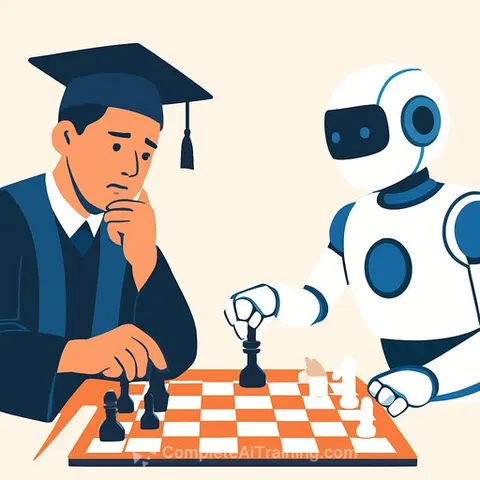
Colleges are spending significant energy policing how students use artificial intelligence - some professors have returned to paper tests and blue books to prevent cheating. But Harvard University Senior Research Fellow Christopher Dede argues those efforts miss the real problem: higher education is teaching skills that AI will soon perform better than humans.
"The problem is that our educational systems are geared to teaching reckoning, and their quality is measured by assessing reckoning, the GRE, the SAT, the LSAT, et cetera, et cetera," Dede told Fox News Digital. "And so what we're doing is preparing human beings to lose to AI as opposed to preparing human beings with skills that complement AI."
Dede spent 22 years as the Timothy E. Wirth professor of learning technologies at Harvard before becoming a research fellow. He also chaired the university's Learning & Teaching program from 2001 to 2004.
Central to his view is the distinction between "reckoning" - calculative prediction - and "judgment," a concept he traces to philosopher Brian Cantwell Smith. Technology excels at reckoning, Dede says, while humans excel at judgment. The two should complement each other, not compete.
Teaching efficiency versus teaching judgment
Most conversations about AI in education focus on doing things better, such as automating traditional teaching methods with generative AI. Dede argues that approach overlooks a larger problem: if AI can teach a skill, the technology will likely perform that same skill in the workplace.
"It's really important to remember that anything AI can teach, AI is going to do in the workplace because it's actually much easier to build a workplace tool that just does whatever the skill is than it is to build a teaching tool that somehow has a glass box on top of the black box of AI so that human beings can learn how to do this," he said.
The focus, he argues, should be on "doing better things" rather than simply "doing things better."
Dede points to active, collaborative and project-based learning and immersive simulation as ways institutions can use AI to develop students' judgment. He gives an example: a student can complete multiple negotiation courses and earn good grades without ever demonstrating the ability to actually negotiate. AI, he says, could change that.
"What AI can do is to mimic the landlord or to mimic a used car dealer or to mimic your boss when you want a raise, and let you rehearse and apply all those wonderful things you learned in your negotiation courses through practice so that when the real world situation comes along, you can give a skilled performance that involves judgment," Dede said.
Generative AI's language capabilities can also analyze what students say and do in during those practice scenarios, offering insight into what they retained from the course.
Limits of AI in professional settings
As AI becomes more common in the workplace, students will need to pair the technology's analytical power with human judgment, rather than rely on either alone.
An AI assistant, for example, could examine large quantities of medical literature and draw insights from patient records. But it lacks the ability to understand pain, morality, or the difference between quantity and quality of life.
"The tools are great for the reckoning part, but they're terrible at the judgment part," Dede said.
He also cautions against relying on AI exclusively for reasoning. Students still need to learn how to think critically so the technology doesn't become "magic." They also need to distinguish between "hallucinatory reckoning" and "genuine reckoning."
Knowing AI tools isn't enough
Simply knowing how to use generative AI may not give students the competitive edge they want, and it can even harm their chances of getting a job.
Dede described a colleague who posted an unpaid internship and received 200 applications. Most of them looked nearly identical. Students had fed information about the internship into generative AI and told it to write a cover letter. The colleague eliminated many candidates immediately.
The anecdote shows why students need skills that set them apart from what AI can produce, Dede said.
But he also says restricting AI in the classroom is the wrong answer. Professors who return to paper tests to block student AI use are "missing the point entirely." Instead, he says, professors should ask why they teach what they teach - and how AI can help students apply it.
Dede is not confident elite universities will change quickly. "I don't know if the elite universities will change, but a lot of the other universities will change in order to survive," he said. "And they'll come out with something that is ultimately far more powerful that's based around demonstrating that their graduates have judgment and understand enough about reckoning that it's non-magic and are capable of thriving on the kind of chaos that we see in the modern world."
Why this matters for educators
For faculty and administrators, the immediate question is not how to police AI or ban it from classrooms. The durable question is a curriculum question: which skills you teach will AI simply perform on the job, and which skills will students need to complement the technology?
Dede's argument suggests that judgment - the ability to apply knowledge in real situations - will be the differentiator. That means building assessments that require practice and application, not just written answers. The urgency is practical: if your institution's graduates can't show judgment that distinguishes them from a tool any employer can license, the degrees you issue lose their value.