
AI news ·
Healthcare AI requires trusted medication intelligence to scale clinical workflows
Clinical AI requires deterministic medication intelligence to ensure patient safety. Health systems lacking this data foundation will lose competitiveness by 2026.
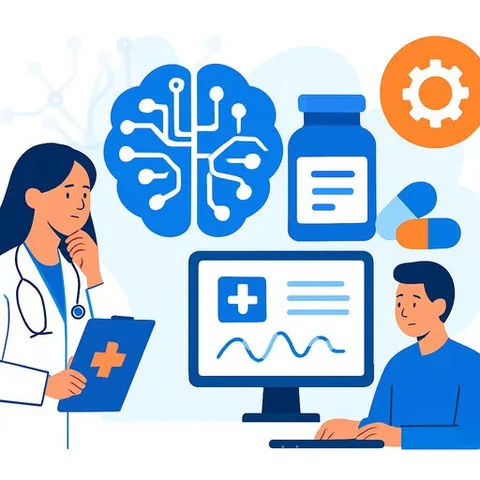
As healthcare organizations push AI from pilots into clinical workflows, a recent webinar from Wolters Kluwer Health and Fierce Healthcare pointed to a missing link: medication intelligence. Medication decisions require consistent, deterministic accuracy - AI that is "often right" is not enough when patient safety is on the line.
For digital health technology companies, this gap will define competitiveness in 2026, especially as AI for Healthcare in pharmacy and medication management becomes central to care delivery. Organizations that embed evidence-based medication data as a foundation, rather than an afterthought, will be able to scale AI safely across clinical and operational workflows.
From experimentation to accountability
AI adoption is already delivering value in administrative areas like clinical documentation and prior authorization. Agentic AI tools are reducing burnout and freeing clinicians to spend more time with patients. But the leap to medication-related decisions introduces a fundamentally different risk profile. Unlike administrative tasks, dosing, interactions, and contraindications demand deterministic outputs - there is no room for probabilistic guesswork.
The foundation: medication intelligence
Medication intelligence is often underestimated in healthcare AI strategies, yet it spans clinical decisions, operational challenges, and ever-evolving therapy guidelines. Technologies like robotic dispensing and automated pharmacy systems can improve accuracy, but only when paired with structured, trusted medication data. Without that data layer, AI cannot reliably help clinicians synthesize fragmented medication histories under time pressure - a daily reality across care settings.
Building trust in clinical AI
Frequent questions about whether AI will replace pharmacists or clinicians miss the point. The most effective models combine automation with human expertise, because medication decisions require context, judgment, and accountability. Building user trust depends on explainability - understanding how outputs are generated - traceability to underlying evidence, and human-in-the-loop oversight to catch errors before they reach patients. This means grounding AI systems in authoritative, evidence-based data rather than relying solely on probabilistic models.
Emerging frameworks like MCP (Model Context Protocol) support this by enabling AI to operate within connected ecosystems. They pull in trusted data and maintain context across prescribing, dispensing, and payer workflows, reducing development burden and improving consistency. Siloed approaches, in contrast, risk unreliable outputs and limited adoption.
Why this matters for healthcare professionals
For pharmacists, clinicians, and digital health teams, the 2026 competitive landscape will favor organizations that treat medication intelligence as non-negotiable infrastructure, not a feature to be added later. The path to trustworthy clinical AI runs through high-impact, workflow-specific use cases grounded in evidence-based data, combined with human expertise and interoperable systems. Those who ignore this foundation will struggle to move beyond pilots, while those who invest in it will deliver safer, scalable AI that supports - rather than replaces - clinical judgment.