
AI news ·
Hiring an AI futurist keynote speaker helps organizations prepare for what comes next
An AI futurist helps executives prepare for what AI could do next, not just what it does today, distinguishing strategy from technical implementation. The value lies in scenario planning for workforce shifts and business-model changes, not in predicting the future perfectly.
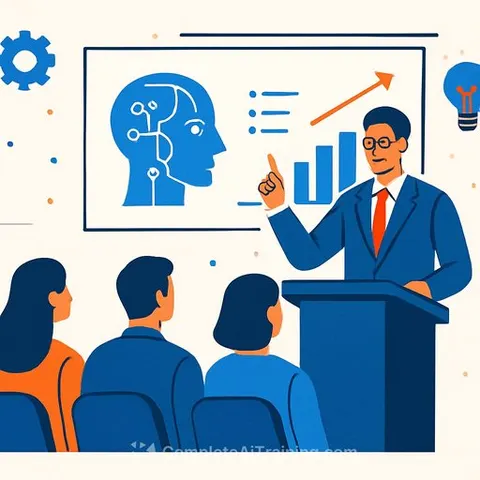
An AI futurist keynote speaker studies how artificial intelligence could evolve and what those changes may mean for businesses, industries, work, and society. Unlike an AI expert who explains what the technology does today, a futurist looks ahead - asking what AI will be capable of next, how it will change the way companies operate, and which jobs and skills will shift.
For executives, the distinction matters. A technical expert can explain how an AI agent functions. A futurist asks what happens to organizations when AI agents can independently perform increasingly complex tasks. The first question is technical. The second is strategic.
AI Futurist vs. AI Expert vs. AI Consultant
These titles are often used interchangeably, but they describe different professionals. An AI expert focuses on how AI works: algorithms, models, data, machine learning, software, and implementation. An AI consultant is hired to solve an immediate business problem - which tools to use, how to automate a process, how to reduce costs.
An AI futurist operates further out. Their questions include: How will AI change our industry? What capabilities will matter five years from now? Which assumptions about our business could become obsolete? What new competitors could emerge?
There is overlap - many futurists also provide strategic consulting - but the time horizon and the questions are different.
What an AI Futurist Does
AI futurists monitor emerging developments and try to distinguish signal from noise. They look for patterns across technological progress, investment, adoption, research, consumer behavior, and business activity. Rather than assuming one outcome, they develop scenarios.
Those scenarios might include AI as an assistant that supports human decision-makers, AI as a workforce that performs entire categories of knowledge work, human-AI teams that divide complex tasks, or autonomous organizations where AI coordinates significant portions of business operations with little human intervention. These are possibilities, not predictions. Scenario thinking helps organizations prepare without pretending the future is certain.
A futurist's work spans generative AI, AI agents, machine learning, automation, robotics, human-AI collaboration, the future of work, consumer behavior, healthcare, finance, manufacturing, leadership, AI ethics, and strategy. They may work as a keynote speaker, advisor, researcher, strategist, author, or consultant.
The Future of Work and Business Models
One of the biggest subjects in AI futurism is employment. AI could automate repetitive tasks, augment human workers, change job responsibilities, create new professions, and eliminate some tasks entirely. The most useful question isn't simply "Will AI take jobs?" It's "Which tasks will change, which skills will become more valuable, and how will organizations redesign work?"
AI also has implications beyond productivity. If AI tools become widely available, competitive advantage may shift toward proprietary data, brand, distribution, customer relationships, trust, organizational capability, and speed of execution. Business models may change - companies might move from selling software to selling outcomes, or from selling human labor to selling AI-powered capabilities.
AI agents are a major focus. Traditional AI responds to instructions. AI agents can plan, make decisions, use software, retrieve information, complete multi-step tasks, and collaborate with other systems. Instead of people using software directly for every task, people could increasingly instruct AI systems to accomplish objectives. That could fundamentally change how organizations interact with technology.
Executives don't need to become AI engineers. But they increasingly need to understand what AI can do, where it creates value, where it creates risk, how employees will be affected, and how competitors could use it. For leadership teams, the goal is moving beyond experimentation and thinking strategically. AI for Executives & Strategy training can help bridge that gap.
How to Evaluate and Hire an AI Futurist
When looking for a speaker, start with the specific problem you want the keynote to address. Search terms might include "future of AI keynote," "AI and future of work speaker," "AI business futurist," or "AI and leadership keynote." Then create a shortlist and examine each candidate's professional background, speaking experience, publications, interviews, keynote videos, and industry expertise.
When evaluating candidates, ask whether they understand AI beyond surface-level trends, whether they can explain why AI matters commercially, and whether they can adapt to the audience. An AI keynote for engineers should not sound like an AI keynote for CEOs. The best futurists are balanced - they explore both opportunity and risk rather than simply promoting AI or predicting catastrophe.
Common mistakes include hiring an AI hype speaker, choosing someone solely because they're famous, confusing technical expertise with futurism, ignoring the audience, and focusing only on short-term tools. A presentation should connect AI to the organization's specific challenges, not just discuss which tool is popular today.
An AI futurist can be particularly useful when your company is developing an AI strategy, your industry is being disrupted, you're hosting a corporate conference or leadership summit, employees are uncertain about AI, or you're exploring automation and future business models. They're also valuable when an organization recognizes that AI is important but hasn't yet determined what it means strategically.
When evaluating a futurist, the most important question isn't "Does this person know a lot about AI?" It's "Can this person help our audience understand what AI could mean for their future?" A technical expert can explain the technology. A consultant can help implement it. An AI futurist helps people see what might be coming next.
Why this matters for executives and strategy leaders
The value of an AI futurist isn't predicting the future perfectly. It's helping leadership teams think more intelligently about a future arriving faster than many organizations expected. AI futurism is ultimately about the relationship between technology, people, organizations, and society - human behavior, economics, culture, regulation, trust, and competition will shape the outcome as much as the technology itself. Executives who understand those dynamics can prepare their organizations for multiple possible futures rather than reacting to whichever one arrives. For a structured approach to building that understanding, an AI Learning Path for CEOs can provide a practical starting point.