
AI news ·
House GOP Proposes 10-Year Ban on State AI Regulations in Sweeping Tax Bill
House GOP proposes a 10-year ban on state AI regulation in a tax bill to create a uniform federal framework. The move faces Senate hurdles amid state pushback.
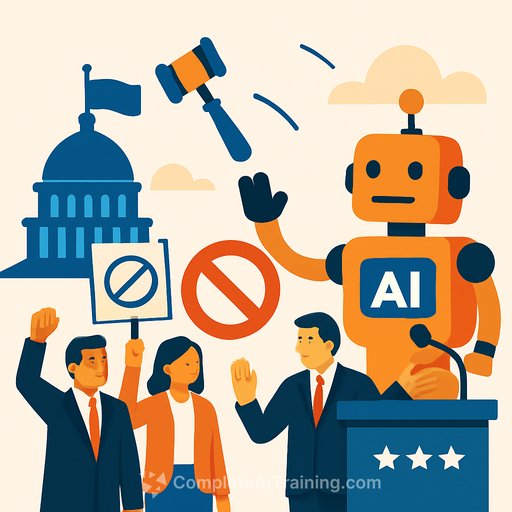
House GOP Proposes 10-Year Ban on State AI Regulation in Tax Bill
House Republicans have introduced a clause in their signature tax bill that would prohibit states and local governments from regulating artificial intelligence for ten years. This provision, added during the House Energy and Commerce Committee’s markup, aims to create a uniform federal approach favoring a light regulatory touch on AI development.
The AI industry supports this move, arguing that a consistent federal framework is essential for innovation and competitiveness, especially against international rivals like China. However, the provision faces significant challenges in the Senate, where procedural rules such as the Byrd Rule may prevent its inclusion in the final legislation.
Senate Concerns and the Byrd Rule
Sen. John Cornyn (R-Texas) expressed doubts about the provision’s chances, noting that the Byrd Rule requires budget reconciliation bills to focus on budgetary issues rather than broad policy changes. Cornyn suggested the AI regulation ban might be viewed as a policy change, potentially blocking it in the Senate.
Despite bipartisan interest in regulating AI, Congress has yet to advance substantial legislation. An exception is a bipartisan bill set to become law soon, targeting stricter penalties for distributing intimate “revenge porn” images—including AI-generated content—without consent.
Arguments for a Federal AI Framework
Sen. Bernie Moreno (R-Ohio) emphasized the importance of federal oversight, stating that AI technology transcends state borders and falls under interstate commerce, which the Constitution empowers Congress to regulate. He acknowledged uncertainty over whether the House’s ban would pass Senate procedures.
The proposed bill language states that “no state or political subdivision may enforce any law or regulation regulating artificial intelligence models, artificial intelligence systems, or automated decision systems.” This would prevent states from regulating AI used in business, housing, hiring decisions, education, government, and more.
State Governments Push Back
This federal push contrasts with recent state efforts. Over half of U.S. states have enacted laws regulating AI deepfakes in political campaigns to combat disinformation, especially after incidents during the 2024 election cycle. Many state legislators and attorneys general oppose the federal ban.
California State Sen. Scott Wiener criticized the proposal on social media, calling it “truly gross.” Wiener authored a bill last year proposing safety measures for advanced AI models, which was vetoed by California’s governor. He argues that Congress is failing to protect the public while also blocking states from acting.
A bipartisan group of state attorneys general also sent a letter opposing the ban. South Carolina Attorney General Alan Wilson stated, “Congress wants to tie our hands and push a one-size-fits-all mandate from Washington without a clear direction. That’s federal overreach.”
Industry Support for Uniform Rules
AI company leaders advocate for a single federal regulatory approach. OpenAI CEO Sam Altman testified that a patchwork of state regulations would burden innovation and slow progress. He supports a “light touch” federal framework that allows rapid development and competition.
Sen. Ted Cruz proposed a 10-year “learning period” with federal preemption to prevent states from issuing comprehensive AI regulations during that time. Altman responded positively to the idea of a single federal approach but was uncertain about the specifics of a decade-long delay.
Microsoft President Brad Smith also supports federal leadership in AI regulation, highlighting the benefits of a consistent framework for product safety and pre-release reviews. This marks a shift from earlier positions where some executives supported state-level guardrails.
Looking Ahead
Ten Senate Republicans have expressed sympathy for creating national AI regulations, but bipartisan consensus remains elusive. Sen. Mike Rounds (R-South Dakota) noted that interstate commerce justifies federal oversight and warned against a chaotic patchwork of state laws.
As AI rapidly integrates into public and private sectors, the debate over who should regulate this technology—states or the federal government—will continue. For government employees and policymakers, staying informed about these developments is crucial as they influence how AI will be governed across the country.
For those interested in expanding their AI knowledge and skills to better understand these regulatory challenges, Complete AI Training offers a range of courses tailored to government and public sector professionals.