
AI news ·
House intelligence committee urges spy agencies to prepare for AI terror risks
House Intelligence Committee warns spy agencies that frontier large language models could make it significantly easier for terrorists to develop and conduct more destructive attacks.
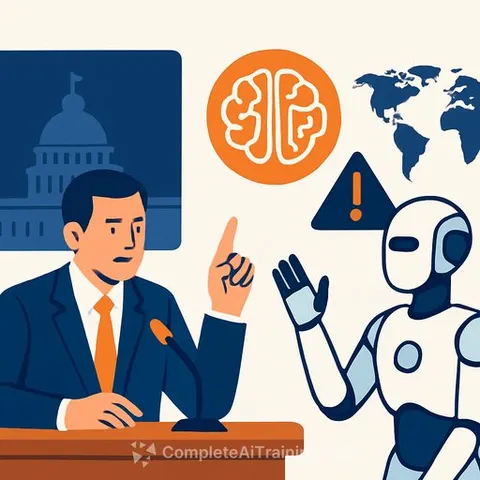
House Intelligence Committee urges spy agencies to prepare for "Black Swan" AI threats
The House Permanent Select Committee on Intelligence warned U.S. spy agencies this week that artificial intelligence could be exploited by terrorists or adversaries to develop more dangerous weapons and plot deadlier attacks. The report lands less than two weeks before the 25th anniversary of the 9/11 attacks, while lawmakers continue to wrestle with how to regulate a technology driving massive economic growth.
The committee's assessment, authored to evaluate U.S. efforts over the past quarter century to address intelligence failures that led to the Sept. 11, 2001 attacks, urges the intelligence community and policymakers to "carefully consider how to prevent AI tools from being leveraged for use by rogue actors, including terrorists."
Frontier models and weapons of mass destruction
The report singles out Generative AI and LLM capabilities as a particular concern. "Frontier large language models have the possibility of making it significantly easier for any rogue actor, including terrorists, to develop and conduct more destructive attacks," the report said.
Preventing terrorist groups from accessing the equipment and expertise needed to build weapons of mass destruction has been a core focus for the intelligence community since 9/11. The lawmakers behind the report - House Intelligence Chair Rick Crawford, R-Ark., ranking member Jim Himes, D-Conn., and Reps. Elise Stefanik, R-N.Y., and Josh Gottheimer, D-N.J. - cautioned that existing safeguards may not keep pace with AI's advances.
"While AI labs seek to prevent models from returning information that could assist a bad actor in, for example, building a bioweapon, the underlying capability of models is developing rapidly and such a use of a model is difficult to fully control," the lawmakers wrote.
Calls for faster adoption and stronger safeguards
The committee urged the intelligence community to accelerate its own responsible adoption of advanced AI capabilities so the United States stays ahead of its adversaries. The report also said investing in "secure AI tools for collection, analysis, and warning paired with rigorous testing, human oversight, and strong privacy and civil liberties protections" is critical to addressing the next generation of threats.
The report's broader conclusion is blunt: the U.S. "faces a threat environment as complex and dangerous as any since September 11, 2001." It adds that "serious gaps remain in our ability to confront and address these vulnerabilities. We are not adequately prepared to confront and address our vulnerabilities."
For government agencies and contractors working on AI for Government, the committee's findings signal that intelligence community investment in secure AI tooling, testing infrastructure, and oversight frameworks will likely expand in the near term.
Why this matters for government, IT, and research professionals
If you work in national security, defense contracting, or federal IT, expect increased demand for AI systems that combine advanced analytical capability with strict human oversight and privacy protections. The committee's report is a clear signal that Congress views AI safety as an intelligence priority, not a secondary concern. Professionals who understand both large language model capabilities and the operational constraints of classified environments will be positioned for the work this report anticipates - whether that means building secure collection tools, designing testing protocols, or implementing oversight mechanisms that satisfy civil liberties requirements.