
AI news ·
How AI and Robotics Are Revolutionizing Every Stage of Real Estate Development and Management
AI and robotics are revolutionizing real estate—from design and construction to smart building management. These tech advances boost efficiency, safety, and asset value.
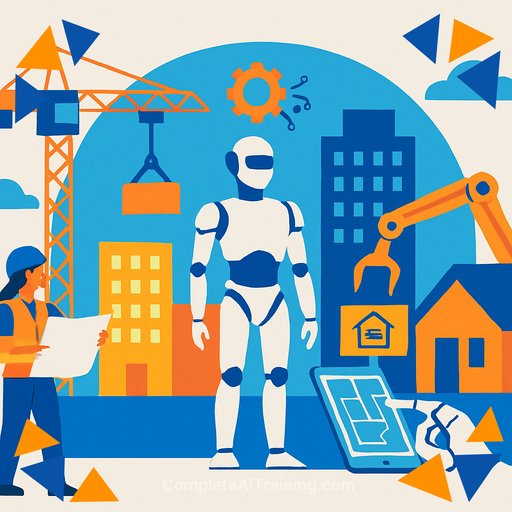
How AI and Robotics Are Transforming Real Estate
Zeno Mercer
May 1, 2025
Summary
AI and robotics are redefining the real estate industry, from initial design to daily building operations. On construction sites, these technologies tackle labor-intensive and hazardous tasks, increasing efficiency and safety. After construction, AI enhances building management through smarter energy use, security, and automation, turning traditional properties into intelligent spaces. This shift opens up new opportunities for investors interested in technology-driven physical assets. This article covers two key areas: physical automation in real estate and AI-powered applications, highlighting companies in the ROBO Global Robotics and Automation Index and the ROBO Global Artificial Intelligence Index.
AI in Design and Planning for Real Estate
Architects and urban planners are using AI to improve design, space utilization, and energy efficiency. AI-powered simulations create “digital twins” of entire cities, allowing teams to test traffic flow, sunlight exposure, and energy use before construction begins. Autodesk’s Spacemaker platform, for example, uses cloud AI to optimize site plans quickly, enabling smarter early-stage decisions that balance cost, aesthetics, and sustainability. By analyzing large datasets like geospatial info and climate data, AI uncovers design solutions far faster and more accurately than traditional methods.
AI and Robotics Transforming Construction
Construction sites are evolving with semi-autonomous and autonomous machines handling tasks once done manually. Drones and ground robots now assist with surveying and progress monitoring, while AI-guided heavy equipment like bulldozers and cranes perform groundwork with minimal human input. These advances reduce risks and improve productivity by automating repetitive or dangerous jobs.
Building Operations, Analytics, and Energy Management
Once a building is complete, AI continues to add value by transforming it into a “smart building.” Sensors and IoT devices collect real-time data on occupancy, air quality, lighting, and equipment status. Platforms like Samsara’s Connected Operations Cloud turn this data into actionable insights, helping facility managers optimize performance and safety. AI-powered computer vision now automates security monitoring by analyzing video feeds and detecting threats without human intervention. Companies such as Ambarella provide specialized chips that enable cameras to perform deep learning directly on-device.
AI also brings more accurate property valuations by processing thousands of features and market trends simultaneously. On the energy front, buildings consume nearly 20% of global energy for heating, cooling, and lighting. Industrial leaders like Emerson Electric and Schneider Electric focus on AI-driven energy management systems to reduce waste and enhance efficiency.
Evolution of Real Estate Usage
The biggest changes may come from how AI-driven technologies alter space usage. Autonomous vehicles and delivery drones could transform urban infrastructure by reducing the need for parking lots and garages. Self-driving fleets can stay on the move instead of parking, freeing up valuable real estate. Companies like Zipline are already partnering with retailers such as Walmart to roll out drone deliveries, signaling a shift in last-mile logistics.
Conclusion and Outlook
The real estate industry is undergoing a fundamental shift powered by AI and robotics. From smarter design and robotic construction to intelligent building operations and changing space demands, these technologies are interconnected forces driving long-term transformation. For professionals in real estate and construction, understanding these trends is critical to leveraging new tools and unlocking value in their projects and portfolios.
For those interested in deeper insights into AI and robotics technologies shaping industries, resources like ROBO Global offer detailed market data and analysis.