
AI news ·
HSBC, Lloyds and NatWest join coalition to develop UK's first sovereign AI model
HSBC, Lloyds, and NatWest signed MOUs on July 3, 2026, to co-design Lumen Sovereign, the UK's first sovereign AI model. It will process all data on UK soil, bypassing US cloud infrastructure.
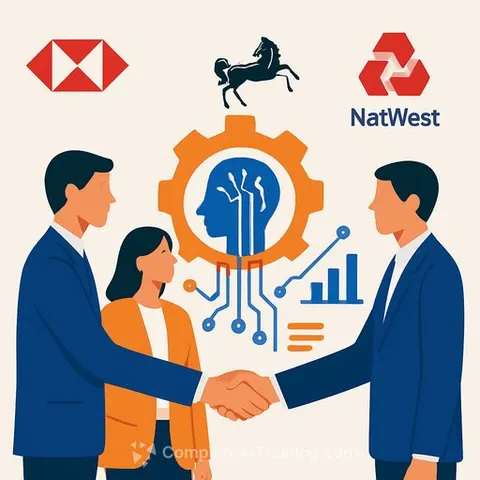
HSBC, Lloyds Banking Group, and NatWest have agreed to co-design what the creators claim will be the UK's first sovereign frontier AI model, a large language system that will operate without US cloud infrastructure or AI providers. British startup Cosine said the banks signed memorandums of understanding on July 3, 2026, to develop Lumen Sovereign, a model aimed squarely at the financial services sector's compliance and data residency demands.
The move marks an acceleration in the UK's effort to build homegrown artificial intelligence that keeps critical workloads beyond the reach of American technology stacks. Cosine will lead the technical build, delivering a model that can handle banking-specific tasks while all processing and model weights remain on UK soil. The coalition is positioning Lumen Sovereign as part of a wider shift toward AI for Finance tools that do not travel through hyperscale data centers abroad.
What makes a model "sovereign"
In this context, sovereignty means the entire lifecycle-training, fine-tuning, inference-happens inside the UK's borders. Cosine did not disclose specific hardware partners, but the approach eliminates dependence on US-based cloud APIs. For the banks, that translates into direct control over data lineage, encryption, and regulatory reporting.
Legacy platforms in banking often lean on cross-border data flows that complicate GDPR and PRA compliance. A sovereign model sidesteps those constraints. Cosine describes Lumen Sovereign as a frontier model, implying it competes on capability with the largest general-purpose systems while adding jurisdictional guarantees.
Co-design with major lenders
HSBC, Lloyds, and NatWest are not just early customers-they will shape the model's feature set during development. Cosine said the memorandums cover active co-design, not passive licensing. That gives the banks a direct line into how the model interprets financial terminology, handles risk assessments, and integrates with internal applications.
The partnership highlights a growing demand for specialized infrastructure skills. Building and deploying a model of this scale without US cloud providers forces IT teams to re-examine network architecture, compute procurement, and model serving pipelines, opening a practical debate around AI for IT & Development strategies that privilege sovereignty alongside performance.
Why this matters for IT and Development
For engineering and operations teams, a sovereign model like Lumen Sovereign changes the deployment playbook. It removes the option of off-the-shelf cloud AI services and requires on-premises or co-located inference clusters, custom API gateways, and audit trails that prove data never leaves UK jurisdiction. IT departments will need to plan for hardware refresh cycles, network isolation, and secure integration with legacy core banking systems.
Skills in Kubernetes-based orchestrations, confidential computing, and regulatory tech will become central to delivering the model in production. As more institutions demand similar independence, professionals who understand how to build and maintain sovereign AI stacks will hold a clear advantage.