
AI news ·
Human values and adaptive education are key to surviving the AI era, professor says
A Sungkyunkwan University professor says AI use is becoming a survival tool, with AI-related firms now holding nearly 50 quadrillion won in combined market cap. He urges education to shift from memorization to adaptive learning that explores how AI reshapes every field.
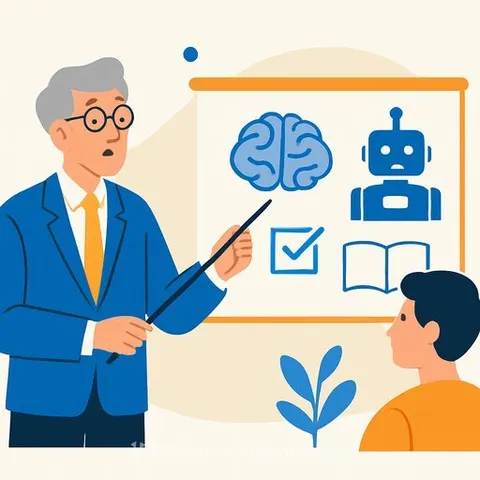
A Sungkyunkwan University professor argues that the ability to use AI is becoming a survival tool, and that education systems must undergo a fundamental shift toward adaptive learning to prepare students for a future no one can predict. Choi Jae-boong, a mechanical engineering professor and author of "AI Sapiens," will deliver a keynote on the concept at the 2026 Korea Times Global Conference on Sept. 15.
Choi, who previously popularized the idea of smartphone-dependent "Phono Sapiens" in Korea, now sees humans evolving into "AI sapiens" - people who use artificial intelligence as a natural extension of the mind. He told The Korea Times that humanity has always chosen tools that improve survival odds, from fire to agriculture. "People are now beginning to realize that the ability to use AI could become such a tool that makes a difference in their survival," Choi said.
The capital flywheel behind the shift
Choi pointed to the movement of capital as evidence of the transition. Two years ago, 10 of the world's 20 largest companies were engaged in AI-related businesses, with a combined market capitalization of 23 quadrillion won. Today, 15 of the top 20 are AI-related, with their combined market capitalization approaching 50 quadrillion won. "What is driving this revolution? It is the 50 quadrillion won of capital in the AI industry," Choi said. "That money has been put into investments, and has been put to work. That is what keeps the flywheel of the revolution turning."
He warned that companies clinging to legacy models risk collapse, citing the struggles of retailer Homeplus and broadcaster JTBC. The latter held exclusive rights to the 2026 FIFA World Cup but suffered a financial setback after Korea's early exit reduced the commercial value of remaining matches. Such pressure, Choi said, will only intensify.
What remains uniquely human
Choi said job displacement is inevitable, with robots replacing portions of the labor force. But he stressed that setting direction, taking on challenges, and making predictions remain human territory. "I believe setting the direction of change, taking on challenges, making predictions and leading that process are areas that remain uniquely human," he said. "We may not know exactly where things are headed, but ultimately, it is humanity that will make the choices."
Success in the AI era, according to Choi, will come from creating something that resonates with human emotions and values - products and experiences people genuinely feel compelled to engage with.
Adaptive learning over memorization
Because people remain at the center of this transition, Choi argued that how the next generation is educated will shape the outcome. He called for a move away from exam-driven memorization toward adaptive learning. Teachers should acknowledge that no one can predict how the AI era will unfold and work alongside students to explore what skills will be needed.
"Universities happened to be built around developing the capabilities required for legacy professions, and OpenAI is not going to tell us what we should study for the AI era," Choi said. "What we need is adaptive learning. If there is something you are interested in, you should ask how it will change with AI. Education should help students track those changes, think deeply about them and build up knowledge and experience along the way."
He emphasized bringing AI into the learning process itself - teaching students how to use it while developing the adaptability and sensitivity required to keep pace with its progress. This approach aligns with the growing focus on AI for Teachers Courses, which help educators integrate these tools directly into their classrooms rather than treating AI as a separate subject.
Why this matters for educators
Choi's argument puts teachers in an uncomfortable but essential position: the curriculum of the past won't prepare students for the economy of the future. The practical takeaway is not to master every new AI tool, but to model adaptive learning itself. When a student shows interest in a topic, the educator's job becomes helping them investigate how AI is changing that field - building research habits and critical thinking rather than delivering fixed answers. Resources like AI for Education can support this shift, but the core change is pedagogical: stop teaching as if the answers are known, and start exploring alongside students.