
AI news ·
IBM bets on software control layer to connect enterprise AI agents and data at Think 2026
IBM is betting its future on the software layer that connects AI models and infrastructure, not the models themselves. At Think 2026, the company pushed agent orchestration and real-time data pipelines as its core enterprise play.
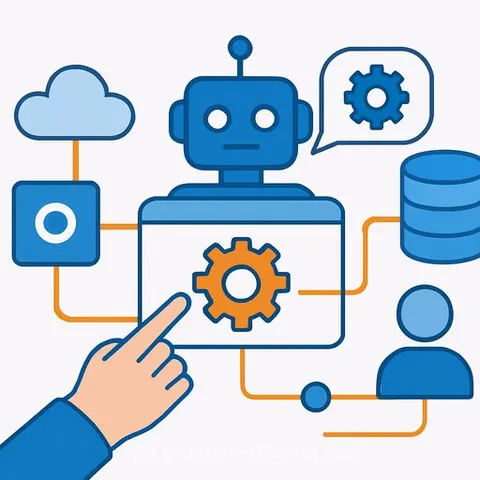
IBM Shifts Enterprise AI Focus to Control Layer, Not Models
IBM is positioning itself above foundation models and hyperscale infrastructure, betting that the next phase of enterprise AI will be won by whoever controls the software layer connecting them.
At IBM Think 2026, the company introduced an "AI operating model" built around data, agents, automation, and hybrid infrastructure. The strategy reflects a shift from isolated AI projects toward coordinated systems embedded in core business processes.
The timing matters. Enterprises are hitting infrastructure constraints tied to AI deployment-data gravity, latency, and rising power demands inside data centers. Over 70% of enterprise data still sits on-premises or at the edge, according to CEO Arvind Krishna. Running AI closer to that data requires hybrid and on-premises architectures, not centralized hyperscale environments.
From Pilots to Enterprise Systems
IBM frames the shift as moving from narrow use cases to enterprise-wide systems. Krishna said companies doing well will see 40% productivity gains from AI. The larger opportunity, he said, is the remaining 60%: new revenue streams and business models.
Analysts agree on the direction but see a structural gap. "Vendors are racing to define the abstraction layer before enterprises are structurally prepared to consume it," said Sid Nag, president and chief research officer at Tekonyx. Most enterprises are still wrestling with fragmented data, inconsistent pipelines, and a lack of production governance.
The Agent Orchestration Problem
At the center of IBM's strategy is Watsonx Orchestrate, positioned as a control plane for enterprise AI agents across tools, models, and environments. Rob Thomas, IBM senior vice president of software, said the focus is shifting from building agents to managing them at scale. IBM now offers a catalog of hundreds of agents from other companies.
The hyperscalers are all building agent platforms. The gap, according to Patrick Moorhead, chief analyst at Moor Insights & Strategy, is environmental. "Cloud companies are building agentic capabilities inside their own sandboxes, but every enterprise is heterogeneous," he said. More than 75% of enterprise data sits on-premises or at the edge, yet cloud agents don't manage on-premises infrastructure.
IBM's positioning as a neutral orchestrator across cloud, on-premises, and mainframe environments creates a near-term opportunity. "The window to entrench is real but not infinite," Moorhead said.
Operations Is Where AI Breaks
IBM is extending its control layer into operations with Concert, a platform that moves from monitoring to automated remediation. The company is using AI to handle patching and fixing at scale.
This is where production AI deployments actually fail. Steven Dickens, analyst and CEO of HyperFrame Research, said the market needs an agent orchestration and governance layer from a trusted third party. Concert targets that operational layer directly.
Moorhead said this is where enterprises are spending: on observability, governance, integration, and data pipelines. "The model has commoditized, infrastructure is maturing, and data modernization is becoming table stakes," he said.
Data Integration Becomes Strategic
IBM is emphasizing real-time data pipelines to support agent-driven systems. The company announced integration of Watsonx.data with Confluent's streaming technologies to provide live context for AI operations.
Moorhead said IBM's data strategy could matter more than its agent announcements. "The Confluent deal is more strategically important than the agent announcements," he said.
For operations teams, this means the foundation for effective AI isn't the model-it's the data pipeline feeding it. Your AI is only as good as your data, Thomas said.
What IBM Isn't Doing
IBM executives were clear about what the company is not pursuing. Krishna said IBM does not build foundation models and partners with most foundation model providers instead.
The company aims to integrate models, manage data, and orchestrate workflows across hybrid environments. That positioning works only if IBM can convert it into proof points beyond its installed base. "IBM has to convert this advantage into reference customers fast," Moorhead said.
Quantum Moves Toward Real Applications
IBM highlighted progress in quantum computing with work at the Cleveland Clinic and RIKEN to simulate a protein system spanning more than 12,000 atoms. The simulation combined quantum systems with classical supercomputers, targeting molecular systems tied to drug discovery.
Broader enterprise quantum use remains years away, but IBM's milestones signal a shift toward targeted scientific applications.
For operations professionals: AI Learning Path for Operations Managers covers the skills needed to implement and manage AI systems in production environments. Also explore AI Agents & Automation to understand how agent orchestration and automated remediation are reshaping operational workflows.