
AI news ·
India’s IPL Playbook for Global AI Leadership
India blends government support with open collaboration, creating a democratic path for AI. With talent, data, and affordable computing, it emerges as a strong global AI contender.
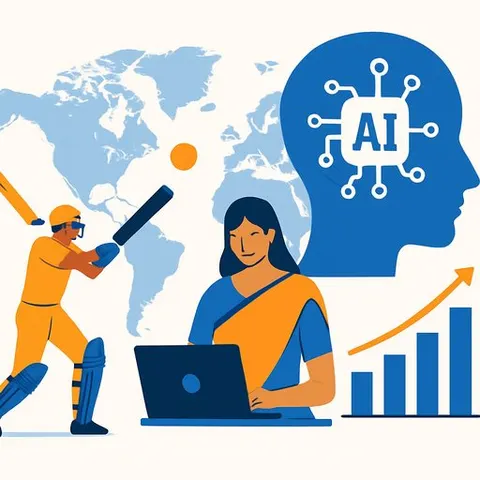
India’s IPL Moment in AI: A Bid for Global Leadership
India’s approach to artificial intelligence stands apart from China’s state-led model and the US private-sector dominance. It blends government infrastructure with open collaboration, creating a democratic and inclusive path for AI development. Once doubted, India now emerges as a serious contender for global AI leadership.
The analogy with cricket’s Indian Premier League (IPL) is striking. The IPL transformed cricket worldwide through clear vision, strategic investment, nurturing local talent, and welcoming global stars—all while engaging diverse audiences. Within a decade, India built one of the most vibrant sporting ecosystems globally. India’s AI strategy follows a similar playbook, aiming to win on the global stage.
India’s Triple Advantage: Computing Power, Data, and Talent
India has launched a new AI computing resource providing 15 million developers access to powerful processors at less than half the global rates—approximately $1.25 per hour compared to $2.50-$3.00 elsewhere. This reduction in cost removes significant barriers for startups and entrepreneurs who previously couldn’t afford the computing power necessary for AI innovation.
One homegrown startup, Sarvam, will use this infrastructure to create India’s first sovereign foundational AI model. This model will focus on deep reasoning and fluency in Indian languages, addressing the diverse needs of India’s 1.4 billion people in real-world applications.
India generates about 20% of the world’s data, providing crucial raw material for AI systems. The government has organized this advantage through AIKosha, a platform offering hundreds of datasets and AI models accessible to developers immediately. India’s data framework balances privacy with innovation, setting it apart globally.
- The Digital Personal Data Protection Act, 2023 has drawn international praise for protecting individual privacy while enabling technological progress.
- The Data Empowerment and Protection Architecture (DEPA) empowers citizens with control over their personal data, allowing its use for technological development without compromising privacy.
Talent is another pillar of India’s advantage. AI hiring surged over 33% in 2024, second only to the US. Stanford research shows India’s AI talent pool grew by 252% faster than any other country. Each year, 25,000 engineers graduate from the Indian Institutes of Technology, alongside the largest group of US-based computer science master’s students and the second-largest group of PhD students.
The government is also establishing specialised AI research centres—Centres of Excellence—to attract both domestic and international experts, creating a fertile environment for innovation.
The Indian Approach: Openness and Collaboration
India’s AI strategy is distinct. Unlike China’s centralized control or America’s market-driven approach, India combines government support with open collaboration. This democratic approach encourages shared standards and inclusive development, enabling ideas to come from anywhere.
India’s success with digital public infrastructure reflects this spirit of openness. Its digital identity system covers 1.3 billion people, and its payment system processes 17 billion transactions monthly for 450 million users. These systems are projected to add 3-4% to India’s GDP by 2030.
This collaborative foundation could provide India a competitive edge in AI, accelerating innovation while ensuring benefits are widely shared.
From Potential to Reality
To translate potential into tangible impact, India must extend AI benefits beyond major cities. Targeted digital literacy programs and region-specific AI solutions will ensure inclusivity, preventing technological power from concentrating in already privileged areas.
Balancing homegrown talent development with attracting global expertise is key. Competitive fellowships and strengthened partnerships between industry and academia can foster a thriving ecosystem where innovation thrives alongside international collaboration.
India should focus on fundamental AI research challenges—such as improving factual accuracy, reasoning, and computational efficiency. This focus could position India as a leader in meaningful breakthroughs rather than incremental improvements, setting it apart in a crowded field.
As AI’s energy demands rise—data centres may consume 21% of global energy by 2030—India’s leadership in renewable energy becomes critical. Nearly half its power capacity comes from clean sources, positioning India to set global standards for sustainable AI development.
Governance frameworks balancing innovation with societal well-being will be essential. Drawing on experience with inclusive digital systems, India can protect individual rights while promoting collective benefits. This balanced approach could define India’s unique contribution to global AI development.
The Long Game
When the IPL began in 2008, few foresaw its global impact. India’s AI journey is similar: clear vision, ready talent, and strong infrastructure are in place. The focus now is on building AI solutions that elevate India from a rising competitor to a global leader.
Success in AI isn't about quick wins but about creating an environment where everyone has the opportunity to innovate and contribute. This inclusive mindset will shape India’s role in the future of AI.
For executives and strategy leaders seeking to understand AI’s evolving landscape, India’s approach offers valuable lessons in combining public infrastructure, data governance, and talent development. Exploring these developments can inform global AI strategies and partnerships.
To explore practical AI training aligned with global trends, visit Complete AI Training’s latest courses.