
AI news ·
Insilico Medicine and Takeda announce AI drug discovery partnership
Takeda will integrate Insilico Medicine's AI platform in a multi-million-dollar deal. It aims to compress early-stage development by automating target and lead discovery.
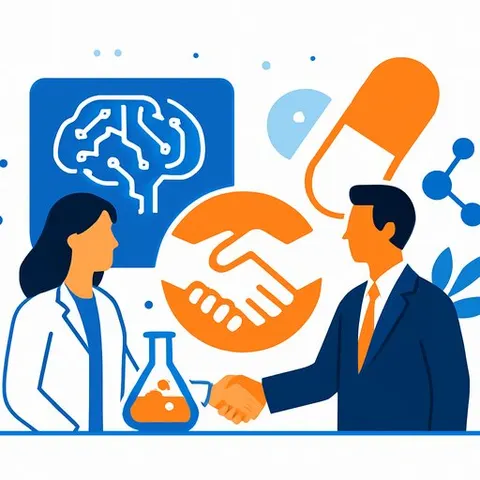
Takeda will integrate Insilico Medicine's AI-driven drug discovery platform into its research operations under a multi-million-dollar deal announced July 5, 2026 in New Delhi. The pharmaceutical giant expects the partnership to compress early-stage development timelines by automating target identification and lead compound generation.
The agreement centers on Insilico's COMPASS system, a computational engine from Insilico Medicine that designs novel molecules and predicts their properties. Takeda gains access to an end-to-end AI pipeline that has already produced clinical-stage assets in fibrosis and oncology. Insilico has previously signed similar alliances with other major drugmakers to apply its generative AI models to disease targets.
What the partnership covers
The collaboration will focus on multiple therapeutic areas. Takeda's researchers will work with Insilico's platform to nominate preclinical candidates faster than traditional methods allow. The platform sifts through billions of chemical structures, evaluates synthesis feasibility, and ranks compounds for activity and safety-all before a lab test is run.
Financial terms beyond the "multi-million-dollar" figure were not disclosed. The deal includes milestones and royalties tied to programs that reach clinical development.
Bottlenecks in clinical integration
Despite the promise, AI-designed molecules still face the same regulatory hurdles as any investigational drug. Drug developers note that accurate toxicity prediction remains difficult for novel targets, and regulators require strong evidence from animal models and human trials. An algorithm's recommendation doesn't bypass the biology.
Clinicians and R&D teams also need to trust the system's outputs. Black-box models that cannot explain their rationale slow adoption in high-stakes environments. Companies like Insilico have made progress in interpretability, but widespread adoption depends on validated case studies, not just computational benchmarks.
Why this matters for healthcare professionals
For biochemists, pharmacologists, and clinical researchers, the Takeda-Insilico deal signals a clear shift in job requirements. AI is no longer a niche experiment inside big pharma; it is becoming the default tool for target discovery. Professionals who understand how to interpret AI-generated hypotheses and integrate them with wet-lab data will have a distinct advantage. Those who don't risk being left on the sidelines as pipelines become more automated.
As this trend accelerates, demand for cross-disciplinary skills is growing. AI for Biochemists Training provides structured learning for scientists transitioning into AI-driven drug discovery. Similarly, AI for Healthcare Courses cover the broader clinical applications that drugmakers and hospitals are now pursuing.