
AI news ·
John Ternus takes over as Apple CEO with Tim Cook stepping back to executive chair
John Ternus takes over Apple with a $55 million stock package and a $4.7 trillion company facing AI pressures. He replaces Tim Cook after 25 years inside the firm, with chip supply and rival AI models as his first tests.
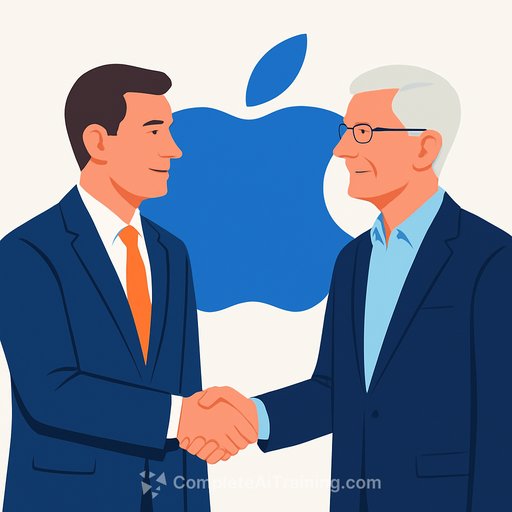
John Ternus will earn $3 million a year plus a $55 million stock package as Apple's new chief executive. The hardware engineer, 51, replaces Tim Cook after 25 years inside the company, taking charge of a $4.7 trillion business with two unresolved AI challenges on his desk.
Cook, who multiplied Apple's value 13-fold during his tenure, will stay on as executive chairman. His role narrows to diplomatic work: managing the relationship with Donald Trump and making periodic trips to China and Europe. That arrangement is expected to hold until the 2028 presidential election.
A low-profile operator
Ternus's public profile is thin. No one in the media knows his parents' names, whether he's married, or if he has children. He has no social media presence. What's known: he swam competitively at the University of Pennsylvania, studied mechanical engineering, and joined Apple's product design team in 2001, shortly after Steve Jobs returned to the company.
Paul Feehery, his college roommate, described him to The Daily Pennsylvanian as diligent and deliberate. "He was always just a very low-key guy. He's very driven academically, very deliberate, and never, never made rash decisions."
That caution has usually paid off. Ternus opposed the Apple car project and the Vision Pro headset. Both failed. He is not a product visionary in the Jobs mold, nor a supply-chain specialist like Cook. What he knows is Apple's product catalogue and the internal machinery that builds it.
The AI battleground
Apple just posted a record quarterly net profit, but Ternus inherits a chip and memory market that has shifted. Data centers now get priority from manufacturers because they buy in volume and pay more. That squeezes a hardware company like Apple.
The second front is strategic. OpenAI, Anthropic, and Google are building the most powerful AI models. Apple's job, as Ternus sees it, is to find the simplest and most useful way to put that intelligence into the hands of millions of people. For product teams watching this space, the question is whether Apple's decision to stay out of large-model development proves wise - or leaves the company dependent on rivals. Professionals evaluating AI for Product Development face a similar build-versus-integrate decision.
Shortly after Ternus took office, Apple unveiled its first foldable iPhone, the most significant physical change to the device in years. But the larger risk is that AI produces a new device category entirely. Jony Ive, Apple's former design chief, is working with OpenAI on hardware that could challenge the smartphone's dominance.
What he brings to the job
Ternus's defining trait showed up early. On his first project, the Cinema Display, he was found at a supplier's facility at night, magnifying glass in hand, counting grooves on a screw head. There were 35 instead of the expected 25. "What the hell am I doing? Is this normal?" he recalled thinking in a speech at Penn. His answer: maybe not normal, but right. "Make no mistake - it's hard to put that much of yourself into something. It's stressful, it requires sacrifice, but it's worth it because our time is finite."
Outside work, he races a Porsche at Laguna Seca and takes coworkers off-road in Washington State. He follows Formula 1. With Apple's leadership team aging out, one of his first tasks is a full overhaul of the executive ranks.
Why this matters for product development professionals
Apple's direction under Ternus will signal whether the industry's most valuable hardware company believes AI belongs in existing devices or in new form factors. Product teams should watch two things: how Apple integrates third-party models into its ecosystem, and whether the foldable iPhone signals a willingness to take physical product risks again. The AI Learning Path for Product Managers offers a framework for evaluating those same integration-versus-build decisions in your own roadmap.