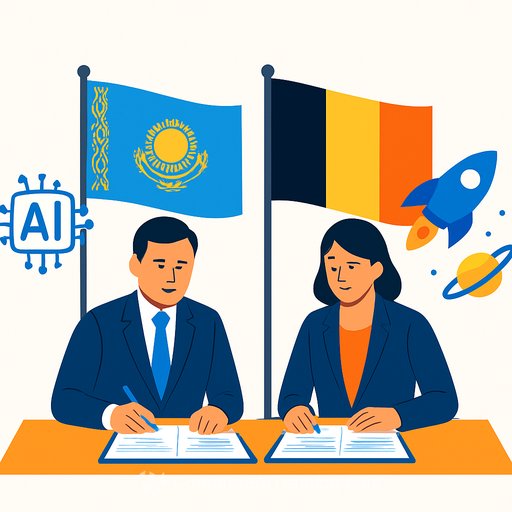
Kazakhstan and Belgium signed multiple strategic agreements on June 23 during President Kassym-Jomart Tokayev's visit to Belgium, targeting joint work in artificial intelligence, scientific research, digital infrastructure, and space technologies. The deals create a direct pathway for Kazakhstan to integrate into the European Research Area through the Horizon Europe program, opening access to funding and international research consortia.
Kazakhstan's Ministry of Artificial Intelligence and Digital Development confirmed the signings. Deputy Prime Minister and Minister of Artificial Intelligence and Digital Development Zhaslan Madiyev and Minister of Science and Higher Education Sayasat Nurbek represented the country at the ceremonies.
University partnerships anchor the research framework
Cooperation agreements were signed with Ghent University and KU Leuven, two of Europe's leading research institutions. The agreements cover joint research, formation of international scientific teams, academic mobility, personnel training, and technology projects aligned with Horizon Europe.
The ministry said Horizon Europe serves as an important mechanism for Kazakhstan's integration into the European Research Area, expanding domestic scientists' participation in international consortia. The new agreements create a practical basis for preparing joint applications, launching research programs, establishing international laboratories, and introducing scientific developments into the economy.
Ghent University's collaboration will focus on mathematical modeling, scientific computing, digital twins, and artificial intelligence. KU Leuven's partnership will cover sustainable materials, critical minerals, engineering education, technology commercialization, and industrial implementation of research.
AI for Science and Innovation agenda takes shape
The agreements also lay the foundation for advancing the AI for Science and Innovation agenda. This initiative uses artificial intelligence to accelerate scientific research, model complex processes, develop new materials and technologies, analyze data, and create innovative solutions for industry and the economy.
The central platform for this work will be ALEM.AI, which brings together artificial intelligence capabilities, universities, research centers, startups, and industrial partners. The ministry described the platform as an entry point for international partners into Kazakhstan's ecosystem and a tool for launching joint projects under Horizon Europe.
"The agreements reached open new opportunities for attracting investment, implementing joint research projects, introducing advanced technologies, and strengthening Kazakhstan's position as one of Eurasia's leading technological hubs," the ministry said.
The International Science and Technology Center (ISTC), which has extensive experience forming international research consortia, will also join the implementation of joint initiatives. This adds institutional weight to the coordination of cross-border scientific projects.
Space and satellite analytics deal targets water management
A joint activity agreement was signed between JSC National Company Kazakhstan Gharysh Sapary and Luxembourg-based Hydrosat S.à r.l., a company specializing in satellite analytics for water resource management and agriculture. The agreement provides for a pilot project titled "Water Resource Management in Kazakhstan Using Copernicus and Hydrosat."
The pilot will apply satellite data to monitor and manage water resources, a pressing concern for agricultural planning and climate adaptation in the region.
Why this matters for science and research professionals
These agreements translate into concrete opportunities for researchers: access to Horizon Europe funding streams, joint application preparation with European partners, and a structured platform for international laboratory establishment. For scientists working in computational modeling, materials science, or AI for Science & Research, the ALEM.AI platform and the Ghent-KU Leuven partnerships signal a growing, funded ecosystem in Central Asia that is actively seeking international collaboration. The ISTC's involvement further reduces the friction of forming multinational research consortia, making Kazakhstan a practical partner for Horizon Europe proposals rather than a peripheral participant.
Your membership also unlocks: