
AI news ·
LangSmith BYOC expands to Azure and Google Cloud
LangSmith BYOC is now generally available on AWS and in beta on Azure and Google Cloud, letting teams keep traces and agent deployments in their own VPC while LangChain handles scaling and updates.
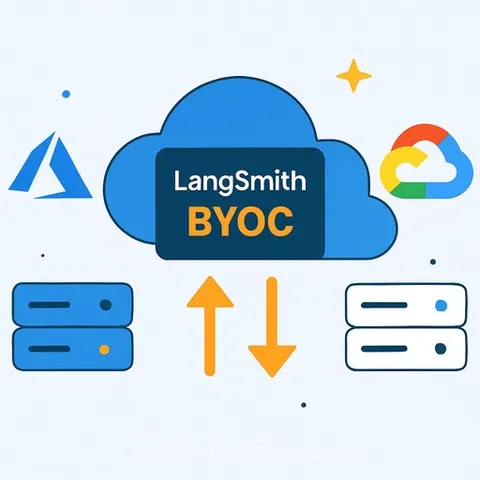
LangSmith Bring Your Own Cloud (BYOC) is now generally available on AWS and has entered beta on both Microsoft Azure and Google Cloud. The expansion lets teams keep their traces, evaluations, datasets, prompts, and agent deployments inside their own cloud accounts while LangChain manages the underlying data plane, from orchestration and scaling to platform updates.
How the control plane and data plane split
BYOC separates LangSmith into two distinct parts. LangChain runs the control plane, which holds authentication, organization and workspace configuration, billing metadata, hashed API keys, and static UI assets. You own the data plane, which contains everything sensitive: traces, prompts, datasets, experiments, agent deployments, and workspace secrets.
An organization can hold several data planes, each in its specific account and region. This lets you split data planes by region, environment, or business unit. A platform team might run production and staging data planes in separate AWS accounts, while a business unit that standardized on Azure runs its own separate BYOC deployment. Each team's traces land in the account that team owns.
What changes for teams running self-hosted LangSmith
Until now, teams with strict compliance boundaries deployed and maintained self-hosted LangSmith. That kept data inside their own boundary, but it required dedicated platform engineers to patch stateful services, configure databases, and run schema migrations. With BYOC, LangChain provisions and operates LangSmith inside your own virtual network. The data stays in your VPC while LangChain handles scaling, schema updates, and runtime dependencies.
Self-hosted LangSmith continues to be a reliable deployment option for customers who require complete control. For teams that need the data boundary without the maintenance overhead, BYOC provides a middle ground.
What early AWS adopters have reported
Since BYOC launched on AWS in August, teams have pointed to three main benefits. Continuous upgrades mean LangChain rolls out platform updates, so teams no longer plan maintenance windows or manage Helm upgrades. New features reach BYOC data planes soon after they ship on LangSmith Cloud, without waiting for the next self-hosted release. Automatic scaling adjusts services with load, delivering consistent uptime as usage grows.
How BYOC runs on each cloud
Each cloud uses its own building blocks, but the core LangSmith experience stays consistent across clouds and deployment options. Traces, trajectories, evaluations, and insights run on the data plane. The LLM Gateway runs in the data plane with support for bringing your own provider keys. LangSmith deployment runs in your cluster, and the engine runs over your data on your own model providers. On all three clouds, BYOC data planes also run Managed Deep Agents endpoints.
On Azure, BYOC runs the data plane inside a dedicated virtual network with a private AKS API endpoint. Istio and KEDA deploy with Helm for ingress routing and event-driven scaling, and system telemetry goes to Azure Monitor. Support for LangSmith Sandboxes on Azure is coming soon.
On Google Cloud, data planes can run in any region and are managed from LangSmith's US control plane. Resources use namespace-scoped names to avoid collisions with existing infrastructure.
On AWS, BYOC runs inside your existing VPC, with the database in subnets you choose. Security teams can attach their own security groups to each application role, so the data plane fits the ingress and egress inspection policies you already run.
Migrating from self-hosted without starting over
The migration happens in two steps. First, you provision the BYOC data plane. Then workspace resources move using an open source migration tool, which reads from your self-hosted instance without causing downtime or data changes. On every cloud, it covers users and roles, datasets, experiments, and prompts, along with annotation queue configuration, automation rules, and dashboards.
Traces, runs, and feedback move as a separate step that LangChain runs with internal tooling. Trace migration is available on AWS today.
Why this matters for IT and development leaders
For IT directors, platform architects, and engineering managers, BYOC removes the operational burden of running LangSmith while preserving the data residency and network control that compliance teams require. The expansion to Azure and Google Cloud means teams no longer need to standardize on a single cloud provider to get managed infrastructure inside their own accounts. The open-source migration tool and public Terraform modules at github.com/langchain-ai/terraform reduce the risk of vendor lock-in, and the split control plane model lets organizations isolate environments by region or business unit without managing separate self-hosted instances. For teams evaluating how to bring AI tooling into governed infrastructure, this approach matches the deployment patterns they already use for other critical services.