
AI news ·
LG Group chairman signs AI cooperation deals with Nvidia, Palantir, Skild AI
LG Group Chairman Koo Kwang-mo signed a strategic partnership with NVIDIA CEO Jensen Huang on August 13, covering humanoid robots, AI factories, and mobility. The deal moves beyond product supply into joint development of AI standards, building on talks that began after their June meeting in Seoul.
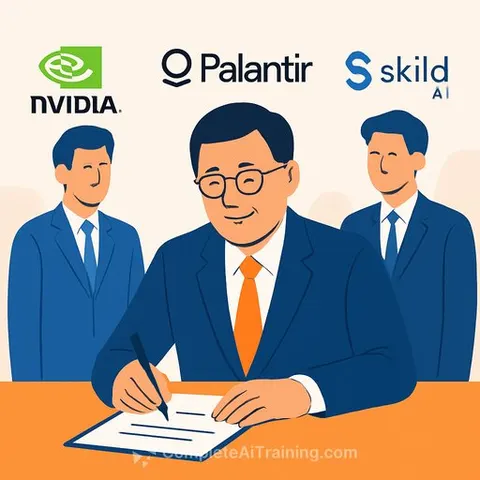
LG Group Chairman Koo Kwang-mo signed a strategic business cooperation memorandum of understanding with NVIDIA CEO Jensen Huang at NVIDIA's headquarters in Santa Clara, California, on August 13. The agreement covers humanoid robots, AI factories, and mobility, and follows working-level talks that began after the two executives met in Seoul in June.
The deal moves beyond product supply relationships into joint development of AI standards and platforms. LG plans to combine its manufacturing and product engineering strengths with NVIDIA's AI computing stack to build what the company calls "industry-leading references" for AI adoption.
"We will accelerate the spread of AI by establishing industry-leading references," Koo said during the meeting.
Huang framed the partnership in broader terms. "Physical AI will transform our daily lives, from homes and factory sites to roads. The combination of LG's leadership in product engineering and manufacturing with NVIDIA's technology is accelerating a new era in robots, AI factories, and autonomous vehicles."
Three focus areas: robots, factories, mobility
LG's strategy centers on three domains where it already has product lines. In robotics, the company operates autonomous mobile robots in hospitality settings - serving, delivery, and guest guidance - and in logistics centers for transport and loading. It has recently moved into home robots using humanoid form factors.
In manufacturing, LG is applying AI to factory operations, an area where AI for Operations has become a competitive differentiator across industrial sectors. The mobility piece covers autonomous vehicles, where NVIDIA's automotive platform would pair with LG's vehicle component business.
Silicon Valley outreach precedes the NVIDIA deal
The NVIDIA agreement follows a broader push by Koo to build relationships with U.S. AI companies. In April, he met with Palantir CEO Alex Karp in Silicon Valley to discuss ontology - Palantir's method for integrating fragmented corporate data and running real-time simulations - and AI-based decision-making systems. Palantir has deployed these tools across manufacturing, finance, and logistics.
Koo also met with Skild AI co-founders Deepak Pathak and Abhinav Gupta, both former Carnegie Mellon professors. Skild AI builds foundation models that serve as the "brain" for robots. LG executives reviewed a humanoid robot demonstration and discussed how the physical AI ecosystem could affect industrial sites.
In 2024, Koo visited Tenstorrent, an AI semiconductor design company, and Figure AI, a humanoid robot startup. Those meetings, like this year's, were part of a sustained effort to assess AI opportunities across the value chain - from chip design to deployed robots.
Why this matters for executives and strategy
For executives tracking AI strategy, the LG-NVIDIA agreement is a useful case study in how industrial companies are positioning themselves. LG is not building its own AI foundation models or competing with NVIDIA's chip business. Instead, it is consolidating internal capabilities across its group companies and attaching them to NVIDIA's platform - a pattern that lets established manufacturers enter the AI economy without owning the full stack.
The Palantir and Skild AI meetings reinforce the same approach: LG is surveying the field, identifying partners with complementary technology, and keeping its options open across multiple AI segments. For AI for Executives & Strategy, the takeaway is that partnership strategy - not just internal R&D - is how large industrial groups are placing their AI bets. The question for any executive is which parts of the AI stack to own, which to rent, and which to leave to partners entirely.