
AI news ·
Livermore lab uses autonomous AI to run experiments without human intervention
Lawrence Livermore National Laboratory now uses AI-driven autonomous systems to run dozens or hundreds of experiments without scientists in the room, compressing weeks of work into weekends.
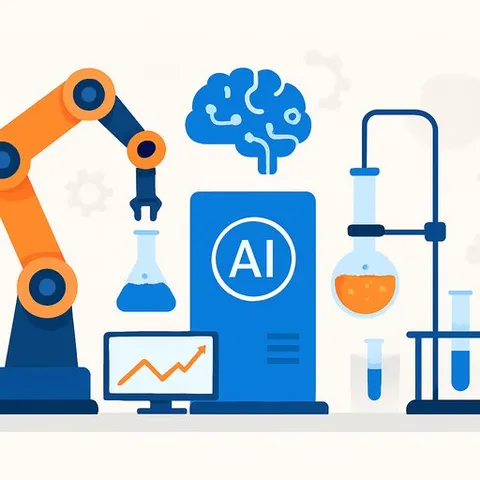
Lawrence Livermore National Laboratory has turned artificial intelligence into an autonomous lab assistant, letting scientists run dozens or hundreds of experiments without being in the room. The work, centered at the lab's Advanced Manufacturing Laboratory (AML), is compressing what once took weeks into weekends and expanding the range of questions researchers can pursue across metal alloys, chemical compounds, and cancer treatments.
AI-driven experimentation is now standard practice at the Livermore, California lab, where staff scientists are moving from a tradition of changing one variable at a time toward platforms that design, execute, and record multiple experiments with minimal human involvement. "We're entering this exciting era, and we're forging that era here at the (Advanced Manufacturing Laboratory) for the next generation of experimenters," said Aldair Gongora, a staff scientist leading AI implementation at the lab. "Whether it's in batteries, whether it's in biology, whether it's in alloys, (scientists) now have at their fingertips the ability to run dozens or hundreds, maybe thousands and - in my dream - millions of experiments."
From machine learning to autonomous experimentation
Early machine learning advances between 2008 and 2014 sped up parts of the experimental process at the lab. But Christopher Spadaccini, Materials Engineering Division leader, says those gains are modest next to what current AI systems can do now they can interact directly with lab hardware.
"We're at the tip of the iceberg right now. We're just learning what this can do," Spadaccini said. "That interface with hardware and the physical world is really exciting, and I think it's set to explode."
As the principal investigator of Project ARMOR (Advanced Robotics for Materials Manufacturing Optimization and Research), Gongora oversees AI automation that spans chemistry, biology, and materials science. Many material properties can only be determined reliably by experiment, which keeps hands-on testing a scientific gold standard.
A scientist's role shifts to orchestration
Autonomous equipment needs human knowledge to act in sequence. Staff scientist Rodrigo Telles builds the connective tissue between AI algorithms and the robots that carry out multi-phase experiments - the steps that tell a robotic arm when it's safe to collect a sample from a centrifuge or retrieve a microwell plate.
"You can't load something in the centrifuge and then think that the robot's going to go grab it, right?" Telles said. "You need to have steps that make sure that the centrifuge is done, your microwell plate is back where you think it's supposed to be, your robotic arm can go and grab it and retrieve it. The AI doesn't really know about that."
Once an experiment is staged, scientists step away. Gongora recalled chemist Sarah Finnegan, who once spent four to six hours pipetting samples into a tube rotator - a process that limited how many hypotheses she could test. She now launches a series of experiments on Friday afternoons and returns Monday to full datasets. For professionals with a Science and Research role, the practical lesson is: design your experiments with automation in mind, freeing your working hours for the analysis that distinguishes memorable findings. An AI Learning Path for Research Scientists outlines this transition step by step for labs preparing similar changes.
Taking a broader view, the expanded scope of experimentation could change the shape of scientific careers and fields. "When you look at PhD dissertations that were written 10 or 20 years ago, especially experimental ones, the amount of experimental data is often very limited," Gongora said.
He draws a direct engineering parallel: as a lab technique, AI may eventually matter to experimental science the way the supercomputer mattered to mathematics. Spadaccini echoes that caution is fit for the moment of early adoption: "I'm not sure we fully understand how AI is going to change how we do science and engineering. It's a hard question to answer because I think it's something so big, it could impact every step in the process. Right now, we're just learning what steps to start with."
Why this matters for science and research professionals
Tackling the full range of AI's implications in a laboratory - from the orchestration of equipment through the work of setting algorithms - remains in an early phase at most institutions. For researchers making the shift, the way forward is a combination of experimentation craft and integrating AI into a professional workflow. Training paths for AI for Science & Research can fill the orchestration gap between technical awareness and practical, lab-ready implementation.