
AI news ·
Managers Trust AI Agents Over Juniors-And Expect to Manage Them Next
Managers increasingly trust AI agents over junior staff as 81% of employees use AI. Stigma and a training gap persist, so establish policy, keep oversight, and train teams.
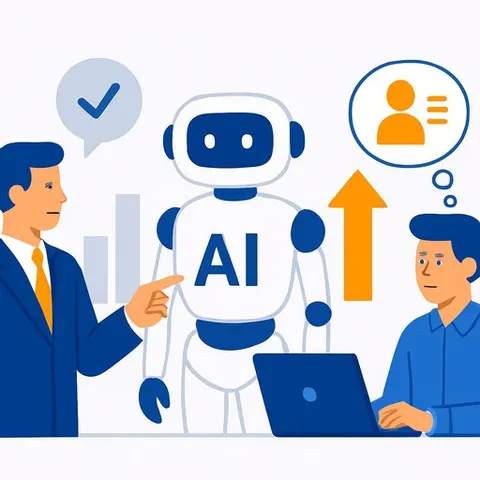
Managers Are Starting to Trust AI Agents More Than Junior Staff
New data from SnapLogic shows how quickly AI has moved into day-to-day work. 81% of employees now use AI tools on the job. 57% use AI agents regularly to save time.
But there's friction. 43% of workers worry they'll be seen as lazy or untrustworthy for using AI, and 24% feel judged or second-guessed. Despite that, trust in outcomes is rising across teams.
What This Means for Management
More than half of respondents (52%) think they'll manage AI agents more than people in the future. 61% say managing agents would be easier than managing humans. 46% even expect they could be managed by an AI agent one day.
As one expert put it: "The future of work isn't about replacing people, but instead using AI as a partner to strengthen what's uniquely human: strategy, insight, and innovation." Treat agents as force multipliers, not headcount replacements.
The Training and Confidence Gap Is Real
Only 36% have formal AI training. 54% are self-taught by trial and error. Confidence is uneven: 70% of managers feel "very confident," but just 33% of non-managers do.
That gap fuels shadow AI, inconsistent quality, and stalled adoption. If you want reliable outcomes, you need structure, training, and clear oversight.
Action Plan: Build an AI-Enabled Team Without Losing Trust
- Publish a clear AI use policy. Define approved tools, data boundaries, review requirements, and where human sign-off is mandatory.
- Create agent ownership. Assign a product-style owner for each agent. Document purpose, inputs, outputs, failure modes, and escalation paths.
- Start with low-risk, high-ROI use cases. Summarization, data prep, QA checks, draft generation. Keep a human-in-the-loop until quality is proven.
- Measure what matters. Track cycle time, error rates, customer impact, and rework. Compare agents vs. human baselines before scaling.
- Level up skills fast. Give everyone baseline AI literacy. Offer role-specific training for ops, finance, sales, support, and engineering. Consider certification to validate proficiency. Explore AI courses by job and AI automation certification.
- Keep juniors in the loop. Pair junior staff with agents. Require rationale notes and reviews. Use agents to accelerate learning, not replace it.
- Adopt a risk framework. Apply access controls, data retention rules, bias checks, and audit trails. Align with guidance like the NIST AI Risk Management Framework.
Hiring and Org Design Implications
- Redesign roles. Expect fewer pure entry-level tasks and more work in orchestration, QA, and exception handling.
- Update career ladders. Reward agent supervision, prompt design, data judgment, and cross-functional problem solving.
- Revamp interviews. Test candidates on how they brief agents, validate outputs, and document decisions.
- Plan headcount with intent. Use agents to free capacity for higher-value work, not to defer strategic hiring.
Practical Guardrails for Agent Trust
- Prohibit agents from final decisions on compensation, termination, legal matters, or safety.
- Require provenance logs for every agent action and output.
- Use dual-control approvals for external communications and high-impact changes.
- Red-team agents before production and maintain fast rollback procedures.
Bottom Line
Managers are warming to AI agents-even more than junior staff in some cases-but trust should be earned through process, proof, and training. Build the system: policy, ownership, metrics, and education. Then scale what works.
The companies that win won't replace people. They'll pair people with AI to compound strategy, insight, and innovation-and they'll train everyone to use it well.