
AI news ·
Mathematicians warn AI race could reshape the future of scientific research
Twenty-five mathematicians warn the AI race could erode human verification standards in research. They caution that accepting machine-generated proofs without scrutiny risks sidelining critical thinking for speed.
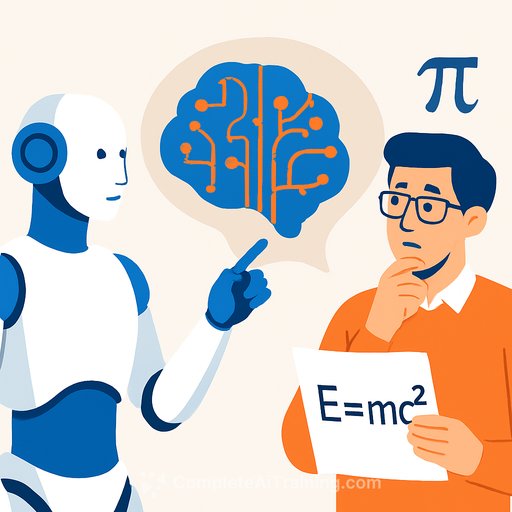
Twenty-five mathematicians and researchers have issued a public warning that the accelerating artificial intelligence race between companies and countries could place unprecedented pressure on the future of mathematical research and the way scientific knowledge is produced. The statement, released from Cambridge, UK, highlights a growing tension within the scientific community: AI systems capable of handling mathematical problems and logical reasoning open tremendous opportunities, but they also raise difficult questions about the role of human researchers.
The group emphasized that increasing reliance on AI tools for problem-solving and proof generation could fundamentally alter the nature of mathematical work. The process of discovering ideas, formulating proofs, and verifying them has traditionally depended on human researchers. Concerns extend beyond machines excelling at computational tasks to include a potential shift in incentives within the scientific community, amplified as the race to develop systems that generate mathematical solutions accelerates.
AI as a scientific tool, not a replacement
The researchers said artificial intelligence can become a powerful tool that assists scientists in discovering new patterns, proposing ideas, and solving complex problems. But its application requires clear rules to ensure the validity of results. They cautioned against automatically assuming a system's output is correct, a practice that could erode the verification standards that form the foundation of mathematical knowledge.
The warning comes as technology companies race to develop models capable of handling increasingly complex scientific and mathematical problems. AI is expected to play a larger role in laboratories, universities, and research centers. For scientists looking to understand how these tools fit into their workflow, the AI for Science & Research landscape is shifting quickly, with new models emerging that can handle tasks once reserved for specialists.
Questions about education and fundamental skills
The rapid pace of development also raises questions about mathematics education. The researchers asked whether students and researchers will continue to acquire fundamental skills in reasoning and logic, or whether reliance on AI tools will become an integral part of the learning and research process. The concern is not about technology itself but about what happens when critical thinking and scientific verification are sidelined in favor of speed.
Despite these concerns, the scientists do not believe halting technological development is the solution. They argued that the key is for AI tools to remain a means of enhancing human capabilities rather than replacing them. For researchers who want to integrate these tools responsibly, structured training such as the AI Learning Path for Research Scientists offers guidance on applying AI without sacrificing the rigor that mathematical work demands.
Why this matters for science and research professionals
For working researchers, the warning is a practical one. The same tools that can accelerate discovery can also introduce errors if outputs are accepted without scrutiny. The mathematicians' core message is that verification remains a human responsibility. As AI systems become more embedded in research pipelines, the ability to critically assess machine-generated proofs and solutions will separate reliable work from flawed results. The incentive structures in your lab or institution may already be shifting toward speed-this statement is a reminder that the scientific method depends on skepticism, not speed.