
AI news ·
Meta acquires robotics AI startup Assured Robot Intelligence to boost humanoid development
Meta has completed its acquisition of Assured Robot Intelligence, bringing the robotics AI startup's team into Meta Superintelligence Labs. Financial terms were not disclosed.
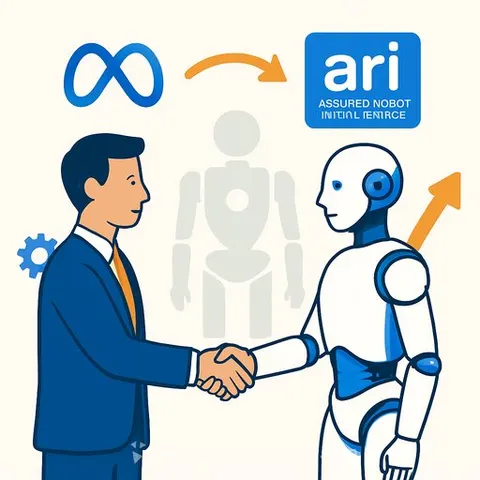
Meta has completed the acquisition of Assured Robot Intelligence, a startup building artificial intelligence models for robots, according to a Bloomberg report confirmed by a company spokesperson. The deal is part of Meta's broader push into humanoid robotics, with the startup's team joining Meta Superintelligence Labs.
Financial terms were not disclosed. Meta described the company as being "at the frontier of robotic intelligence designed to enable robots to understand, predict and adapt to human behaviors in complex and dynamic environments."
What Meta is getting
Assured Robot Intelligence (ARI) describes its work as building frontier AI for robots to address labor shortages in high-value markets. Co-founders Lerrel Pinto and Xiaolong Wang will join Meta's research division and work closely with Meta Robotics Studio, the team launched last year to develop underlying humanoid technology.
Wang previously worked as a researcher at Nvidia. Pinto co-founded Fauna Robotics before leaving in 2025; Amazon acquired Fauna in March for its own humanoid robotics program. This isn't Meta's first robotics acquisition - it's part of a pattern of big tech companies pulling specialist AI and robotics research teams in-house.
For developers tracking AI for IT & Development, the deal underscores how much robotics research depends on people who have experience shipping at hyperscaler and autonomous-vehicle infrastructure levels.
The competitive picture
Tesla showcased Optimus Gen 3, its latest humanoid robot, in Shanghai in early 2026. The robot uses the same "AI5" inference chips found in Tesla's current vehicles, with a final reveal planned for late 2026. Google, meanwhile, announced a partnership with Agile Robots SE in March to deploy reasoning-capable robots in industrial manufacturing.
All three companies are targeting the same core problem: getting machines to reason about unstructured physical environments rather than just follow scripted movements. Meta is approaching this from the model-development side, which fits its computing and AI infrastructure strengths. The broader generative AI and LLM skill set - training, fine-tuning, and evaluation pipelines - transfers directly to this kind of work.
Why this matters for IT and development professionals
The acquisition points to a growing overlap between AI model development and physical systems. For engineers and developers, the practical takeaway is that the skills used to train LLMs - data pipelines, model evaluation, deployment infrastructure - are now in demand for robotics work at major tech companies.
That shift matters for career planning. Robotics is no longer a niche mechanical engineering field; it increasingly runs on transformer-based architectures and simulation environments that software engineers already know. Expect more job postings that mix AI research and physical system deployment, alongside continued investment in reasoning models that can handle real-world uncertainty.