
AI news ·
Mit professor uses three grok bots to design, simulate, and 3d print parts from four photos in under an hour
Three Grok bots turned four unrelated photos into two 3D-printed structural parts in under an hour, using just 19.48 grams of plastic and a $1,749 desktop printer.
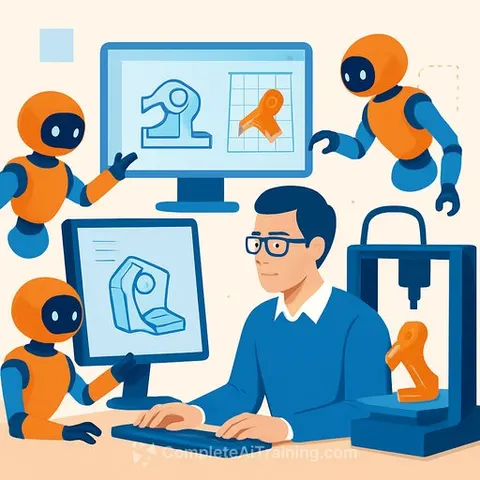
An MIT professor gave three Grok bots four unrelated photos and a complex mechanics problem. Within an hour, the AI team designed, simulated, and 3D-printed two physical parts - without a million-dollar automated lab.
Markus Buehler, the Jerry McAfee Professor of Engineering at MIT, posted the results on September 6. The three agents - all Grok Bots from xAI - worked in relay: interpreting images, writing a physics simulator from scratch, running 47 experiments, and exporting model files to a desktop printer. The total material cost for the final parts: 19.48 grams of plastic.
"Are we already living in the future?" Buehler wrote.
A staffing framework built for production
The division of labor followed a framework xAI released in early beta on August 11. Each Grok Bot gets its own cloud computer and can log into accounts and operate web interfaces like a human. Multiple bots work in parallel under a coordinating agent.
Buehler's team had three roles. The Chief of Staff tracked progress across the other two agents, transferred files, and kept work moving - the only role that produced no direct deliverables. The Physics Experimenter read images, wrote simulators, ran experiments, and submitted a research report in LaTeX. The 3D Printing Bot handled slicing, generated manufacturing code, sent tasks to the printer, and monitored the build.
xAI's official documentation put the goal plainly: "There is a world of difference between completing 90% of a task and completing 100% of it." Most AI stops at the report stage. Grok Bot aims for the finished object.
Four images, zero engineering drawings
Buehler provided two inputs: four reference photos and a research question. The images - a pinnate leaf vein, a Voronoi-like mesh, a random fiber lattice, and a radial spider web - shared no scale, subject, or alignment. No CAD files existed.
The research question asked how hierarchical depth, redundancy, disorder, and interlayer strength affect stiffness, peak load, and energy absorption when total material is fixed. In plain terms: why are leaf veins and spider webs both light and strong, and at which step does structural hierarchy actually matter?
Buehler did not specify which software to use or how to build the model. He asked the agents to infer transferable design principles from the images and build an experimental platform for fracture research.
Within 20 minutes, the Physics Experimenter had written an interactive 2D layered Euler-Bernoulli beam network simulator from scratch. It named the tool HIER-FRACTURE v1.0.0, ran nine self-checks in 220 milliseconds, and passed all of them before beginning formal work.
47 simulations, one overturned hypothesis
The agent ran 47 simulation experiments, reserving six for holdout testing - data never used in parameter tuning, held back specifically to validate conclusions. This is standard practice among human experimenters, not a behavior most AI workflows exhibit unprompted.
The results were counterintuitive. With fixed total material, stiffness across structures varied by at most 20%. Impact resistance, however, varied dramatically - the best design absorbed several times more energy than the worst.
The mechanism came down to material competition. Adding auxiliary fine structures thins the main beam. Networks with deeper hierarchies often performed worse under impact than simple single-layer lattices. Weak interlayer connections acted like fuses: they broke first, spreading force and shifting the failure mode from sudden collapse to progressive collapse.
Before experiments began, the agent set a hypothesis labeled H2: additional hierarchies hurt performance because interlayer connections were too weak. After 47 runs, it overturned its own hypothesis. The real reason was simpler - fixed material means adding layers steals material from load-bearing elements. The agent noted the correction in its report.
Software interfaces become robotic hands
The Chief of Staff sorted results by fracture energy, selected two designs, and handed model files to the 3D Printing Bot. The bot opened Bambu Studio slicing software, connected to a printer named Leonas3DP, placed both models on one build plate, scaled them uniformly by 50x, set parameters, and clicked send. It then monitored the printer's camera as the nozzle laid down plastic.
Grok Bot did not drive the printer motor directly or use a custom API. It operated the graphical interface the same way a human operator would - clicking buttons, adjusting settings, watching the live feed.
This is the step that changes the cost equation. Previous automated science demonstrations required either modified equipment or robotic arms. The University of Liverpool's robotic chemist ran roughly 700 experiments in eight days using a robotic arm, but the lab cost millions of dollars. Buehler's setup used a desktop 3D printer available on e-commerce platforms for $1,749.
Modern manufacturing already runs through software - CAD, slicers, machine tool consoles all have GUIs designed for human operators. Those interfaces are now accessible to Grok (from xAi) bots that never get tired.
Why this matters for science and research professionals
This demonstration does not replace researchers - Buehler selected the images, defined the research question, and stayed in the loop throughout. But it shows that the barrier between AI for Science & Research and physical output has dropped dramatically. When agents can operate standard software interfaces, any instrument with a GUI - oscilloscopes, CNC machines, microscope consoles - becomes programmable by an AI that writes its own tools, runs its own experiments, and corrects its own hypotheses. The bottleneck is no longer equipment cost or custom integration. It is the quality of the research question a human asks.