
AI news ·
Nadda opens AI-enabled E-ICU command centre at Ghaziabad hospital
India's health minister inaugurated an AI-enabled E-ICU Command Centre at Yashoda Medicity in Ghaziabad to bolster district-level critical care. The government aims to certify all 1.81 lakh Ayushman Arogya Mandirs under NQAS within two years.
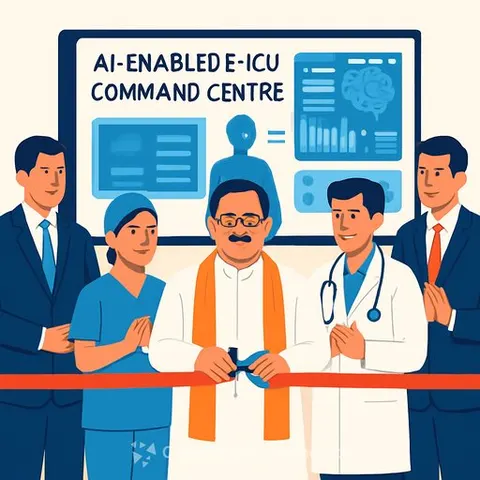
India's Union Minister for Health and Family Welfare, Jagat Prakash Nadda, inaugurated the AI-Enabled E-ICU Command Centre at Yashoda Medicity in Ghaziabad on Thursday. The new facility aims to strengthen critical care services at the district hospital level by improving clinical coordination and supporting on-ground medical teams through structured guidance.
Nadda said AI-enabled healthcare allows for timely intervention, precision in diagnosis, and real-time monitoring, all of which matter most in emergency and intensive care settings. He pointed to the broader government push behind the initiative: more than 1.81 lakh Ayushman Arogya Mandirs have been operationalized across the country, with over 50,000 centres already certified under the National Quality Assurance Standards (NQAS).
Quality targets and AI governance
The government has set a target to bring every Ayushman Arogya Mandir under NQAS certification within the next two years. Nadda mentioned that the SAHI Portal and the BODH Initiative, launched during the India AI Impact Summit, are meant to promote ethical and validated use of AI in healthcare.
Why this matters for healthcare professionals
For clinicians and hospital administrators, this signals a shift toward AI-supported workflows that standardize treatment and backstop bedside decisions with real-time data. District-level staff stand to gain structured guidance tools for critical care, while planners get a clearer template for how government expects AI to fit into public health delivery over the next two years. Healthcare professionals who understand how these systems are being deployed - and where their limits are - will adapt faster to the changing operational environment.