
AI news ·
Nadella sidelines execs to let engineers lead Microsoft's AI strategy
Satya Nadella is moving AI calls to the builders: weekly messy demos, direct feedback, fewer layers. Execs are asked to ship like ICs as Microsoft speeds decisions, product truth.
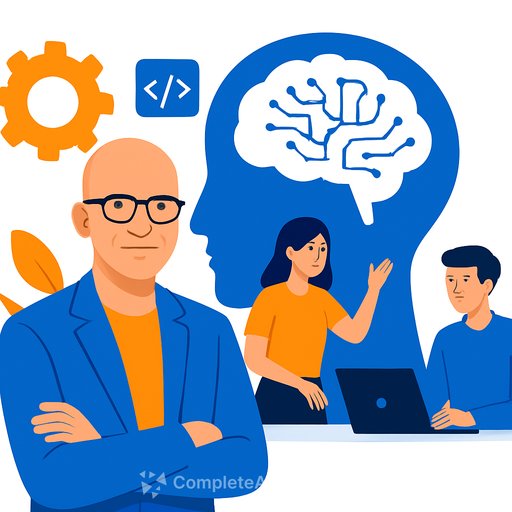
Satya Nadella flips Microsoft's AI decision-making: engineers in, executives sidelined
Microsoft is retooling how big calls on AI get made. Satya Nadella has set up a weekly "AI accelerator" where senior managers don't present - engineers and hands-on staff do.
The goal is direct signal, no corporate filter. Feedback runs through a dedicated Microsoft Teams channel, and the sessions are intentionally "messy and chaotic" to surface real constraints and ideas fast.
Why this move matters for executive teams
This breaks the usual enterprise pattern where strategy is shaped by layers. Nadella wants decisions anchored in what's actually being built, not slideware.
For leaders, the message is clear: compress the distance between the people writing code and the people allocating capital. The faster that loop, the better your odds in AI.
Operating cadence: intensity, urgency, and "middle innings"
Internally, Nadella has shifted tone from "early days" to "middle innings." That framing forces focus-execution now, not theoretical planning.
Executives have been asked to "work and act like ICs," emphasizing continuous learning, unlearning, and a bias for shipping. Titles matter less than contributions.
Leadership reshuffle to protect time for core tech
Judson Althoff has been elevated to lead Microsoft's commercial business, giving Nadella more bandwidth for AI and product decisions. Senior leaders have reportedly been asked to either commit to the workload this demands or consider stepping aside.
It's a capacity test at the top: fewer meetings about the work, more work that moves the needle.
Implications for India and other engineering hubs
With Microsoft expanding cloud and data center capacity in India, a bottom-up model increases the leverage of strong engineering teams. Karnataka and similar hubs stand to gain as frontline developers gain more direct influence on AI priorities.
Expect hiring, incentives, and career paths to tilt toward builders who can ship reliable models, safety tooling, and AI-enabled products.
How executives can apply this playbook
- Create an unfiltered forum: Run a weekly AI stand-up where ICs demo live work. No slides. No proxies.
- Shorten the loop: Centralize feedback in a single channel (chat + async video). Decisions documented within 24-48 hours.
- Set contribution norms: Ask directors and VPs to own code, prompts, model evaluations, or data pipelines at least monthly.
- Fund bottlenecks, not org charts: Allocate budget to the teams closest to latency, data quality, evals, and safety issues.
- Adopt "ship-to-learn": Move from quarterly releases to weekly increments with clear guardrails.
Risks to manage
- Shadow governance: Speed without safety reviews invites legal and brand risk. Stand up an approvals path that's fast and auditable.
- Engineer overload: Direct access can lead to context-switching. Protect maker time with strict meeting limits.
- Signal vs. noise: "Messy" forums work only with crisp decision logs and owners. Close the loop on every issue raised.
What this signals about AI competition
Companies that compress hierarchy to reach the builders will iterate faster on model integrations, guardrails, and customer utility. The center of gravity shifts from presentation polish to shipped outcomes.
If you lead a business unit, the advantage is operational: fewer layers, quicker decisions, higher-quality product truth. That's how you win adoption and margin in AI.
Source context: Internal communications and reporting indicate Microsoft is running this model with weekly forums and IC-first input. Coverage referenced by Business Insider.
Level up your org's AI capability
If you're retooling roles and workflows for AI, align skills to the new operating model. Leaders should review curated guidance for different responsibilities: AI for Executives & Strategy, AI for Management, and AI for Product Development.