
AI news ·
Navigating AI in New Zealand Schools: Ministry of Education's Stance Amid Calls for Clearer Guidance and Literacy
New Zealand's Ministry of Education urges schools to create clear AI policies to ensure responsible use. AI literacy for teachers and students is vital amid growing adoption.
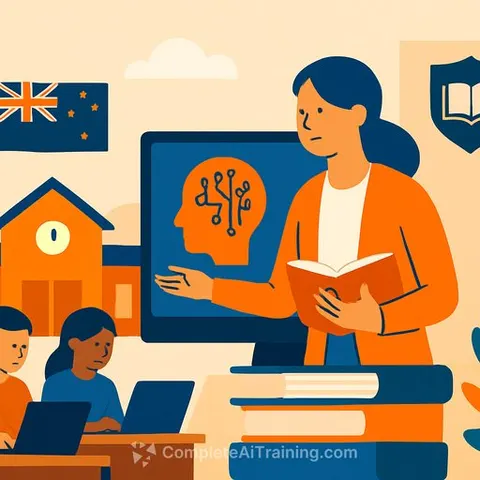
New Zealand Ministry of Education Responds to Calls for Clearer AI Guidance in Schools
The Ministry of Education in New Zealand has urged schools to create an AI Policy that clearly defines acceptable use of artificial intelligence in educational settings. Recognising the challenges AI brings, the Ministry emphasises that responsibility for AI use lies with individual school boards. A recent survey found that 60% of young people use generative AI to assist with schoolwork, highlighting the technology’s growing role in education.
Current AI Governance and Challenges
Pauline Cleaver, Acting Leader of the Curriculum Centre, points out that AI poses important issues schools cannot ignore. These include algorithmic bias, which can reinforce existing inequalities if AI systems aren't designed inclusively. Privacy concerns also arise around student data collection and ownership.
The Ministry does not mandate AI usage but encourages schools to establish policies that support responsible integration. Cleaver stresses that AI should serve to enhance teaching and learning, assisting skilled teachers rather than replacing them.
Need for Clearer Guidance and AI Literacy
Associate Professor Kathryn MacCallum from Canterbury University highlights that AI adoption varies across schools, partly due to unclear guidance from the Ministry and the New Zealand Qualifications Authority (NZQA). She argues that stronger AI literacy is essential, especially for teachers.
“If we do not train all teachers and students on how to use AI, we risk further exclusion,” MacCallum said. She recommends embedding AI literacy within the curriculum to reflect its impact across all learning areas.
Education Ministry’s Perspective and Ongoing Efforts
Education Minister Erica Stanford acknowledges that the Ministry’s current guidance could be improved. She notes that many countries face similar challenges in addressing AI's role in schools.
Stanford describes the Ministry's approach as cautiously exploratory. NZQA has been trialling AI in assessments with promising results. For example, from May 2025, Automated Text Scoring will be used for digitally submitted Literacy Writing assessments. This technology reduces marking time and eases the workload on teacher markers by allowing marking outside school holidays.
NZQA Deputy Chief Executive of Assessment, Jann Marshall, confirms that while AI tools speed up marking, human checks remain essential to ensure quality. However, MacCallum points out that NZQA’s stance on AI in assessments remains risk-averse, particularly regarding generative AI use in external exams.
Looking Ahead: Developing a National AI Framework
The government has committed to establishing a national framework to provide clearer AI guidance, similar to Australia’s model. Minister Stanford admits progress has been slower than desired due to extensive curriculum rewrites and reforms to the National Certificate of Educational Achievement (NCEA).
“We’re rewriting every curriculum area right up to Year 13 because it doesn’t exist at the moment,” she said. “We’re fundamentally changing NCEA to make sure that it’s fit for purpose, bringing in new assessment tools.”
Despite the challenges, there is a clear understanding that AI will play an increasing role in education. Preparing teachers and students to use AI responsibly and effectively remains a priority.
Additional Resources for AI Education
- For educators seeking to enhance their AI skills, Complete AI Training offers courses designed for education professionals.
- Those interested in AI literacy and prompt engineering can explore specialised prompt engineering courses to better understand AI interaction.