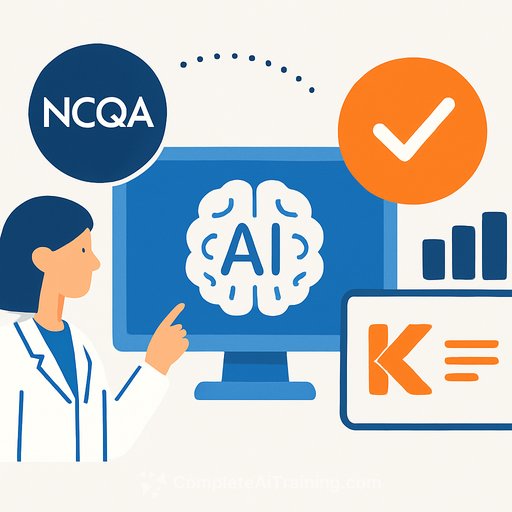
The National Committee for Quality Assurance (NCQA) has selected Komodo Health to support quality measure development using AI, a move that touches more than 236 million patients enrolled in insurance plans that rely on NCQA's Healthcare Effectiveness Data and Information Set (HEDIS).
HEDIS is the most widely used set of performance measures in American healthcare, and health plans use it to track everything from cancer screenings to diabetes management. The partnership signals that AI is moving into the core infrastructure of how quality in American medicine gets measured and reported.
Komodo Health brings its healthcare data platform into the fold, which aggregates claims data, electronic health records, and other clinical information. For NCQA, the goal is to modernize how quality measures are constructed and validated at a time when the volume of healthcare data has grown beyond what traditional methods can handle efficiently.
What the partnership covers
NCQA evaluates and certifies health plans, and its HEDIS measures are used by the vast majority of American health insurers. The organization's work directly influences payment decisions, network design, and public reporting across the industry.
By working with Komodo Health, NCQA is looking to use AI to analyze larger datasets and identify patterns that inform how quality measures are created. This includes testing whether proposed measures accurately capture the care patients receive and whether they can be reliably reproduced across different health plans and data sources.
The collaboration is relevant to professionals working in provider organizations, health systems, and medical groups, since HEDIS measures often determine how their performance is evaluated by payers. For those in the broader healthcare field, understanding how AI is entering quality measurement is becoming part of the job. Professionals tracking these developments may find value in following AI for Healthcare resources to stay current on similar applications.
Why AI in quality measures now
Traditional measure development relies heavily on manual review and smaller datasets. That approach is slow, and it struggles to keep pace with the complexity of modern care delivery, which spans multiple settings and generates enormous volumes of structured and unstructured data.
Komodo Health's platform processes de-identified data from over 330 million patients, giving NCQA access to a scale that individual health plans cannot match. The AI component is designed to help identify gaps in care, test measure validity, and surface potential unintended consequences before measures are rolled out broadly.
For insurance professionals, the shift has direct implications. Health plans are evaluated on HEDIS scores, and those scores affect accreditation, star ratings, and revenue. If AI changes how measures are developed, plans may need to adjust how they collect and submit data. Those working in insurance operations may want to track how these changes unfold through coverage of AI for Insurance.
Why this matters for healthcare professionals
Quality measures are not abstract administrative tools. They shape which treatments get reimbursed, how providers are ranked, and what patients see when they compare plans. If AI makes those measures more accurate and more current, the effect will ripple through contracting, care management, and public reporting.
For clinicians and administrators, the practical takeaway is that the data they document today will increasingly feed AI-driven quality systems tomorrow. The accuracy and completeness of clinical documentation will matter even more as AI tools rely on that data to evaluate performance. Understanding how these systems work is no longer optional for professionals who want to influence how their organizations are measured.
Your membership also unlocks: