
AI news ·
New bioethics investigator studies how AI in patient messaging affects trust
A new bioethics study of 31 patients and providers finds both sides worry AI-drafted messages will erode trust, with patients holding clinicians fully accountable for AI errors. Researchers say transparency about AI use must be standard as hospitals integrate tools from Epic and Microsoft.
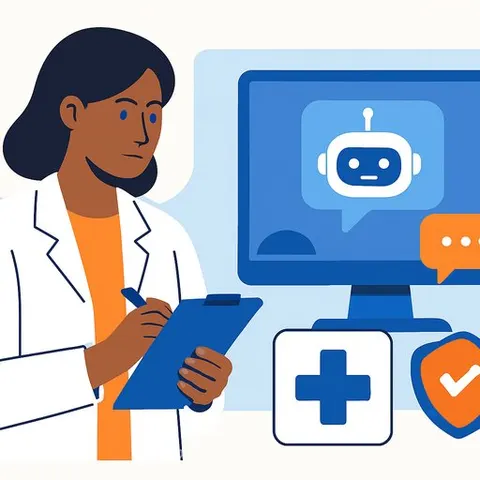
Patients have mostly been left out of the conversation as hospitals rush to add AI to patient-doctor messaging. Quinn Waeiss, a new bioethics investigator at the Morgridge Institute for Research, is trying to fix that by studying how large language models are changing secure messaging systems - and what that means for trust between patients and providers.
Before joining Morgridge this month, Waeiss worked at Stanford University as a postdoctoral scholar at the Center for Biomedical Ethics. In their most recent project, Waeiss conducted in-depth interviews with 31 participants - 20 patients and 11 providers - about how secure messaging is used, what both sides expect from it, and what happens when mistakes occur.
"Suddenly, almost everyone in the country is relying on secure messaging by virtue of necessity, because we can't be seeing our doctors in person to the degree that we had previously," Waeiss said. "And yet we really didn't have a good understanding of how secure messaging itself was reshaping the relationship."
The stakes are rising as AI gets added to the mix. Epic and Microsoft, two of the nation's largest providers of electronic health records, have been integrating AI capabilities into their systems to improve productivity and ease workload constraints.
Common ground between patients and providers
Waeiss found both groups agree on the current system's benefits: secure messaging increases access to providers, reduces financial burden, and speeds up communication. But both sides also reported that the system has created significant workload burdens.
"People are literally leaving [our healthcare institution] because the In basket burden is so high," one healthcare provider said.
Both patients and providers also said that the multi-staff triage used to answer secure messages can cloud relationships. One patient reported feeling a "huge betrayal" when writing a sensitive health note to their doctor and getting a response back from someone different. Patients were more likely to describe secure messaging as "impersonal," while providers often said patients "use messaging unrealistically."
What changes when AI drafts responses
When asked about AI drafting provider responses, both groups expressed concerns about a loss of human connection and trust, the prospect of "miscommunication loops," and whether AI would actually reduce work burdens. On the question of disclosure, patients and providers agreed that transparency should be the standard. And when mistakes happen, both groups held a firm line: the provider is responsible if AI errors slip through.
One patient's comment captured the unease: "Just test me for everything and then put a computer on it and it can evaluate me just like I was a car in a garage! That scares me. It's not the whole person …"
Waeiss sees the pattern as compounding problems rather than solving them. "It's kind of like we're building a Jenga tower of technological solutions to the problems we've identified in the past," they said.
The research connects to broader questions about how Generative AI and LLM tools are being deployed across clinical settings. Waeiss is continuing this work at the University of Wisconsin-Madison as an assistant professor in the Department of Medical History and Bioethics, where they are partnering with bioethics scholar-in-residence Pilar Ossorio on the Research Ethics Consultation Service.
Why this matters for healthcare professionals
For clinicians and administrators, the findings point to a practical warning: AI drafting patient messages may save time, but it shifts accountability squarely onto the provider. Patients expect transparency about AI involvement, and they hold the clinician - not the technology - responsible for errors. That means healthcare organizations need clear policies for when AI is used in messaging, and providers need to know they cannot delegate judgment to the tool.