
AI news ·
New book offers tools for spotting misinformation and AI deepfakes
A new book by Dr. Genevieve Bjorn and Adam J. Burgasser offers practical tools for verifying claims and spotting AI deepfakes. The authors stress that skepticism alone isn't enough, providing a repeatable process to trace claims and separate evidence from assertion.
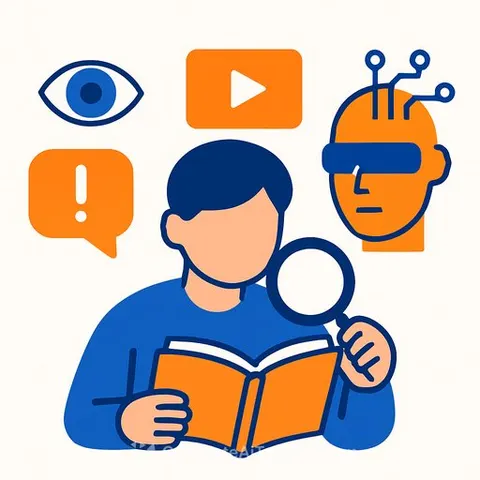
Sorting fact from fiction is getting harder as misinformation spreads online and AI deepfakes become more convincing. A new book aims to give readers practical tools to evaluate scientific theories and non-scientific claims by breaking down information to better determine what is true.
Authors Dr. Genevieve Bjorn and Professor Adam J. Burgasser are promoting the book and discussing how it can be used to assess information and get to the truth. The book arrives as professionals across industries face a rising tide of manipulated media, fabricated quotes, and distorted statistics in their daily work.
What the book covers
Bjorn and Burgasser focus on methods for evaluating claims systematically rather than relying on intuition or surface-level credibility signals. The approach applies to scientific research papers, news articles, social media posts, and even casual conversations where questionable assertions surface.
For writers and editors, the stakes are immediate. A single unverified claim or undetected deepfake can damage credibility, trigger retractions, or spread harmful misinformation to thousands of readers. The book's framework offers a structured way to verify sources and separate evidence from assertion.
The authors emphasize that skepticism alone is not enough. Readers need concrete techniques for tracing claims to their origins, identifying logical fallacies, and recognizing the patterns that distinguish authentic content from AI-generated fabrications. Those skills apply directly to AI for Writers workflows, where generative tools produce text that requires careful verification before publication.
Why verification matters now
Deepfake technology has advanced rapidly, making it difficult even for trained observers to spot manipulated video and audio. The book addresses this challenge by teaching readers to focus on consistency, sourcing, and corroboration rather than trying to detect imperfections in the media itself.
Scientific claims present another layer of difficulty. Research findings often get oversimplified or distorted as they travel through press releases, news coverage, and social media. Bjorn and Burgasser's framework helps readers trace claims back to original studies and assess whether conclusions match the actual evidence.
The methods also apply to evaluating AI Research outputs, where language models can generate plausible-sounding but incorrect information with confidence. Understanding how to verify AI-generated content has become a core skill for knowledge workers.
Why this matters for writers
Writers face a double challenge: they must verify the information they consume and the information they produce. The book's tools offer a practical path through both. By applying structured evaluation methods, writers can protect their reputations, serve their audiences with accurate information, and maintain trust in an environment where misinformation is increasingly common.
The authors' core message is straightforward: truth is determinable, but only with deliberate effort. The book provides the scaffolding for that effort, giving readers a repeatable process rather than vague advice to "be careful." For working professionals who depend on reliable information, that process is becoming as essential as basic research skills.