
AI news ·
New York school district pauses AI robot deployment over privacy and manufacturer concerns
A New York district paused a $60,000 AI robot deployment over the maker's ties to a sex doll company. State officials and teachers also raised data privacy concerns.
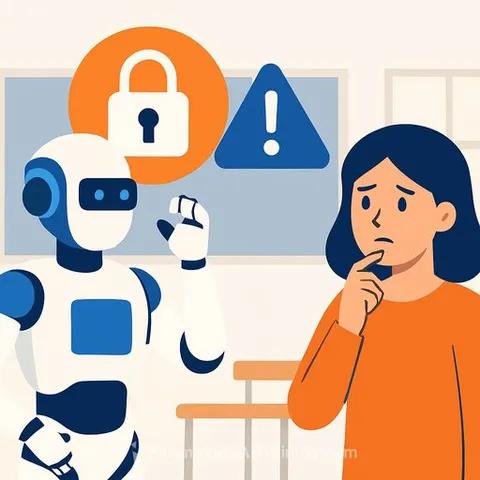
A rural school district in upstate New York has paused the planned deployment of a $60,000 AI-powered humanoid robot in its high school after state officials, teachers, and parents raised alarms over data privacy and the manufacturer's link to a sister company that produces hyper-realistic sex dolls. The decision by Salamanca City Central School District illuminates the tension between ambitious technology rollouts and community vetting in K-12 education.
State officials and teachers voice concerns
New York Education Commissioner Betty Rosa sent a letter to the district Friday questioning how the robot would be used, even after staff confirmed it would not deliver classroom instruction. She noted that a prior presentation had characterized the device as a "tutoring platform." A teachers union quickly opposed the purchase, targeting the maker's corporate ties. Melinda Person, president of New York State United Teachers, said bluntly: "A robot built by a company associated with sex dolls has no business in our classrooms."
Unionized teachers suggested the pilot was a first step toward replacing human educators, despite the robot nicknamed "Sally" having movable arms and hands but non-functioning legs. Person added: "Our students don't need robots. They need real relationships with caring adults."
District officials defend the purchase
Superintendent Mark Beehler stressed that the robot is an instructional tool, not a replacement for staff. "There is no possible way a robot can replace a human in a school," he said. "Teaching is a human-to-human process." The district had already budgeted for the stationary robot to help high school students in robotics and technology classes-explaining concepts like Arduino boards and offering hands-on troubleshooting practice.
Beehler, connected to the Las Vegas-based company Realbotix through a former colleague, said the robot is pre-loaded with WozEd, a curriculum from Apple co-founder Steve Wozniak that the district already uses. The district maintains that "Sally" will not collect student personal information, record audio or video, or send data back to Realbotix. All interactions are stored locally, and the life-sized unit draws roughly the same power as a laptop.
Last year, a San Diego charter school bought two AI-powered robots from a U.K. firm for $500,000. As more districts explore AI for Education, such pilots attract sharper scrutiny from families and regulators alike.
Robot maker responds to criticism
Realbotix pushed back against the characterization that "Sally" was a repurposed adult product, calling it a "newly manufactured, purpose-built educational unit" with no modified hardware. The company said its Realbotix LLC subsidiary focuses on healthcare, education, and other non-adult commercial applications, while a separate entity, Intima LLC, holds an ownership stake in a sex doll manufacturer. "Realbotix LLC and Intima LLC have different product offerings with no crossover," the statement read. "The two subsidiaries maintain their own management, personnel, payroll, facilities, manufacturing operations, product development, and market strategies."
Student authentication would flow through the district's existing systems, the company added, with any student-linked information remaining encrypted and under district control.
Community skepticism and next steps
Some residents in the small community on the Seneca Nation of Indians reservation remain wary. Joplin Ficek, a local, expressed concerns alongside others about how student data would be handled. Beehler argued that for an isolated district like Salamanca-where students often travel one to two hours to see emerging technology-the robot is a way to "level the playing field." Still, the pilot is now on hold while the district negotiates enhanced data privacy agreements with the state and continues community outreach.
Why this matters for General, Education, IT and Development professionals
Data governance and vendor due diligence: For IT and development teams building or procuring AI tools for schools, this case highlights the need to scrutinize not just a product's features but also the parent company's portfolio and public perception. Clear, verifiable data privacy protocols and local data storage-rather than cloud-based sharing-become non-negotiable selling points when pitching to cautious school boards.
Addressing workforce fears head-on: Teachers' swift opposition reflects a common anxiety that AI automation will erode frontline jobs. Education and IT leaders must pair technology rollouts with transparent communication and professional development. Providing educators with structured resources, like an AI Learning Path for Teachers, can help defuse fears by shifting the conversation from replacement to augmentation, while building internal capacity to manage new tools responsibly.