
AI news ·
New York Times drops book critic after AI tool copies lines from rival review
The New York Times cut ties with book critic Alex Preston after he admitted an AI tool copied phrases from another writer's review without his knowledge. Preston called it a "complete failure of judgment."
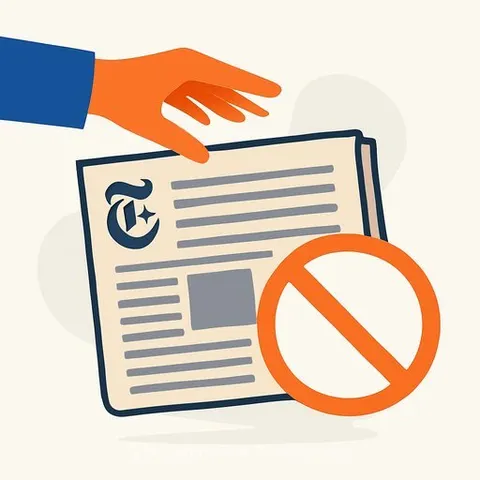
New York Times fires critic for using AI that plagiarized another review
The New York Times ended its relationship with book reviewer Alex Preston after he admitted to using an AI tool that lifted phrases from another writer's review without attribution. Preston said he asked a large language model to expand a draft of his critique in January and did not realize the program had taken lines almost verbatim from Christobel Kent's Guardian review of the same novel.
When a reader flagged the similarities to the Times, Preston confessed and apologized. He called it a "complete failure of judgment" and said he had used a tool he "didn't understand."
The wider problem with language models
Large language models (LLMs) are trained on massive datasets to generate human-like text. The problem: they can reproduce existing writing without signaling when they're doing so, and they sometimes produce false information entirely.
Angus Finney, a fellow at Cambridge Judge Business School, said Preston's case will become increasingly common. "The mimicry and speed and fluency of these LLMs is very seductive," Finney said. "They seem like they are offering you the world at your fingertips, but if you don't double- and triple-check, they'll bite your fingers off."
LLMs have a particular vulnerability: they generate plausible-sounding answers even when they lack factual basis. Finney estimates that 10% to 20% of search results produced by LLMs in media and creative work will be wrong.
Copyright theft at scale
Preston's plagiarism incident sits against a larger backdrop of copyright infringement. AI companies trained their models on millions of books without permission or compensation to authors.
Anthropic agreed last September to a $1.5 billion settlement with authors over copyright infringement related to roughly 500,000 pirated books used to train its Claude model. That sounds substantial until you divide it by the number of books: authors receive roughly $3,000 per book. Anthropic's recent valuation reached $380 billion.
The settlement deadline for authors to file claims against Anthropic was last Monday.
What writers should know
Different publications have different standards. Some newsrooms encourage AI for writers to increase efficiency. Others reject any AI involvement to preserve the writer's voice and authority.
In Britain, the Society of Authors launched a "human authored" scheme allowing members to certify their work contains no AI-generated content.
Preston is not alone in recent months. Matt Goodwin, a former academic and defeated Reform UK candidate, was accused of using nonexistent quotes and dubious statistics in his self-published book. Peter Vandermeersch, former chief executive of Mediahuis Ireland, was suspended after a Dutch newspaper found he had used AI to produce dozens of false quotes in his articles. Eight of his pieces were removed from the Independent.ie website.
Hachette Book Group pulled Shy Girl, a horror novel, from its U.S. roster after allegations that its author had relied heavily on AI to write it. The author denies the claim. The book was also discontinued in the UK.
The education problem
Finney argues the damage extends into schools and universities. Teachers increasingly use AI to create assignments and tests, which encourages students to use AI to complete them. The cycle creates a shortcut mentality that undermines knowledge and critical thinking.
Students face temptation similar to Preston's: use an LLM to draft an essay, then check for errors. What gets lost is the process of developing distinctive prose and genuine understanding.
AI-detection tools themselves often misidentify AI use, creating another problem. According to the Chronicle of Higher Education, some students now use AI to check their own work for AI flags.
The conscious choice question
The fundamental issue with AI and plagiarism is consciousness. Traditional plagiarism is a deliberate choice to pass off someone else's work as your own. With LLMs, the line blurs.
Preston may have genuinely not understood what the tool was doing. But that ignorance doesn't erase the result: another writer's words appeared in his review without credit. For readers and editors, the outcome matters more than intent.
AI is a tool, not a solution. Its convenience and responsive tone are designed to encourage dependency. For writers, that dependency carries real professional risk.