
AI news ·
Nvidia adds 64GB DGX Spark for local AI agents
NVIDIA bumped its DGX Spark to 64GB unified memory so developers can run multiple AI agents locally on one box. The upgrade lets a single machine handle workloads that once required a GPU cluster, keeping sensitive data on-premises.
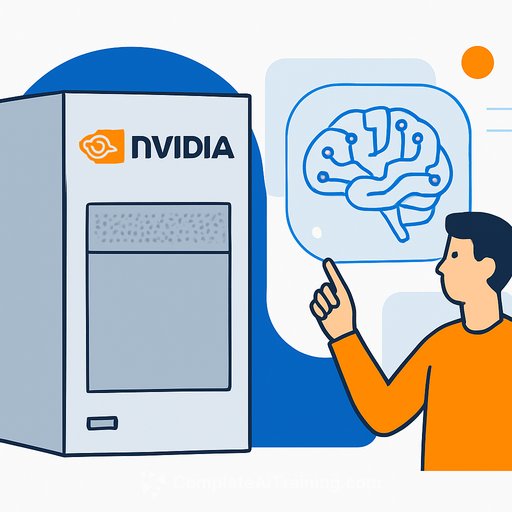
NVIDIA has upgraded its DGX Spark platform to a 64GB unified memory configuration, targeting developers and enterprises that want to run AI agent workloads on local hardware instead of in the cloud. The memory bump lets a single machine host larger language models and multiple agents at once, which cuts cloud dependency and keeps sensitive data on-premises-an immediate concern for regulated sectors.
What the hardware delivers
The DGX Spark uses NVIDIA's Grace Blackwell architecture, pairing a CPU and GPU to push up to 1 petaflop of AI performance. With 64GB of unified memory, users can execute real-time inference and complex multi-agent systems without splitting workloads across remote servers. One beta tester said that a multi-agent retrieval-augmented generation pipeline, which previously required a GPU cluster, "now executes smoothly on a single DGX Spark."
The system ships with an optimized software stack that includes TensorRT-LLM and NeMo, alongside support for orchestration tools such as LangChain and LlamaIndex. Developers can migrate existing models or fine-tune them directly on the device. NVIDIA has not published pricing, but analysts expect it to be competitive with other high-end AI workstations, with availability in the coming months through direct sales and select partners.
Running multiple agents on one box
The 64GB variant can host several AI agents simultaneously-customer service, data analysis, and code generation, for example-without significant performance drops. That parallel processing capability matters for workflows that need models to collaborate in real time. It also reduces the constant cloud connectivity that drives up operational costs and exposes data in transit.
Industries handling sensitive information stand to gain the most. Healthcare, finance, and manufacturing environments often require low-latency responses and strict data controls. Local deployment on the DGX Spark removes the round-trip to a cloud endpoint, which can be the difference between a useful agent and one that arrives too late.
The edge AI context
Demand for edge AI and local inference is rising as organizations blend cloud resources with on-premises systems. NVIDIA positions the DGX Spark as a bridge between those worlds: enterprise-grade performance in a form factor that fits standard server racks or high-end workstations. The company has also hinted at future updates, including larger memory configurations and stronger networking for distributed training.
For teams building agent-based workflows, the platform's integration with popular frameworks lowers the barrier to entry. Instead of stitching together disparate cloud services, developers can prototype and deploy on a single machine. That shift compresses development cycles and opens the door to real-time decision-making in mission-critical settings. Professionals looking to deepen their skills in this area can explore AI Agent Courses that cover multi-agent design and orchestration.
Why this matters for technical and operations professionals
If your work involves sensitive data, latency-sensitive applications, or compliance requirements that make cloud AI a hard sell, a 64GB local node changes the math. You can run a stack of cooperating agents behind your own firewall, iterate faster, and avoid per-query cloud costs. For IT and development leaders evaluating on-premises AI strategy, AI Technology Leadership Courses provide frameworks for matching hardware investments to agent workloads. The DGX Spark won't replace cloud infrastructure, but it gives teams a concrete option to keep critical inference local while still tapping into larger models.