
AI news ·
Nvidia pays $6 billion to license Poolside AI model software and hires 109 employees
Nvidia will pay $6 billion to license Poolside's Model Factory software and hire 109 employees, plus invest $1 billion at a $12 billion valuation. The deal isn't an acquisition, and Poolside's co-founders will stay.
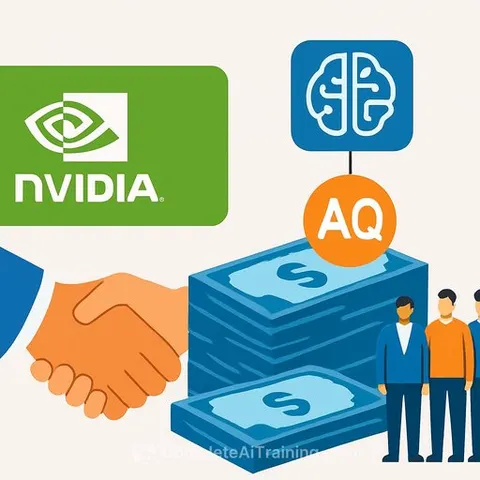
Nvidia will pay $6 billion to license Poolside's AI model-development software, Model Factory, and will make offers to hire 109 Poolside employees who worked on the company's open-source model, Laguna, according to a letter Poolside sent to investors. The letter was reported Thursday by Newcomer and The Information. Nvidia will also invest $1 billion in Poolside at a $12 billion pre-money valuation, and Poolside's three co-founders will remain with the company.
The letter said the deal is not an acquisition or an acquihire, a deal primarily involving talent. Neither Nvidia nor Poolside immediately replied to PYMNTS' request for comment.
Poolside said in its letter that on its own, it would have needed more access to Nvidia hardware than was possible if it were to continue competing in the development of open-source models. Nvidia has become a major developer of open-source models.
Nvidia's pattern of licensing and hiring
This deal follows a similar structure to several recent Nvidia moves. In December 2025, Nvidia acquired talent and tech from Groq, a maker of custom-built inference chips. Nvidia entered into a non-exclusive licensing agreement for Groq's inference technology and hired Groq's founder, president, and other team members. Groq continued to operate as an independent company.
"We haven't acquired Groq. We've taken a non-exclusive license to Groq's IP and have hired engineering talent from Groq's team to join us in our mission to provide world-leading accelerate computing technology," an Nvidia spokesperson told PYMNTS at the time.
CNBC reported in September 2025 that Nvidia spent over $900 million to license the technology of AI hardware startup Enfabrica and hire the company's CEO and other employees. Enfabrica's technology can connect more than 100,000 GPUs and enable them to effectively serve as a single computer, according to the report.
In June, Nvidia acquired predictive AI software startup Kumo AI for $400 million. In December 2025, Nvidia acquired SchedMD and said it would continue to distribute that company's open-source Slurm software, a workload management system for high-performance computing and AI.
What the Poolside deal means for AI development
The Poolside deal gives Nvidia control over Model Factory, a platform for building and fine-tuning AI models, along with the team that built Laguna. Poolside's co-founders staying with the company suggests the startup will continue operating, but its core development talent is moving to Nvidia.
For developers, the pattern is consistent: Nvidia is assembling teams and technology through licensing agreements rather than full acquisitions. This approach lets Nvidia bring in specific technical capabilities and engineering talent while leaving the original companies intact. For IT and development professionals tracking the AI infrastructure market, the takeaway is that AI for IT & Development teams are increasingly being reshaped by these hybrid deals.
Why this matters for IT and development professionals
If you work with AI models or infrastructure, the Poolside deal signals that Nvidia is moving beyond selling chips and into controlling the software stack that runs on them. The company is now licensing model-development platforms and hiring the engineers who build them. That could affect which tools and frameworks become standard in the industry, particularly for teams working with open-source models.
Developers who build on open-source AI models may want to watch how Nvidia's involvement changes Poolside's Laguna and Model Factory. When a hardware vendor takes control of a model-development platform, priorities can shift toward integration with its own infrastructure. For those building careers in this space, understanding how these deals reshape the AI toolchain is becoming part of the job. An AI Learning Path for Software Developers can help you track these changes and build skills that remain relevant as the market consolidates.