
AI news ·
OpenAI claims a solution to the Navier-Stokes problem, beating two mathematicians who were working on the same proof
OpenAI deployed roughly 10,000 AI agents for 88 hours to produce a 166-page proof of the Navier-Stokes problem, one of seven Millennium Prize problems carrying a $1 million award.
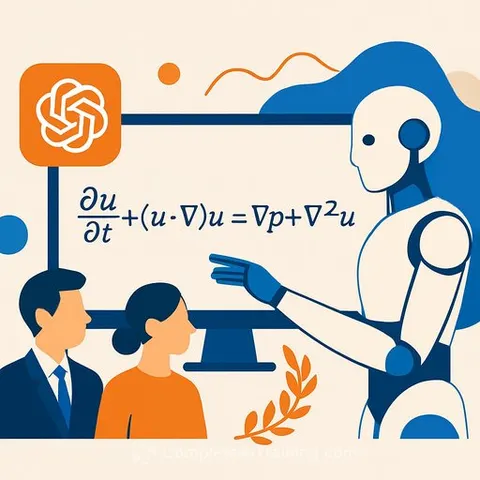
Tristan Buckmaster, a mathematics professor at New York University, and Levent Alpöge, a mathematician at Anthropic, were weeks into a breakthrough on the Navier-Stokes problem when OpenAI announced Tuesday that its AI agents had solved it first. The result, if verified by the broader mathematical community, would resolve one of the seven Millennium Prize problems and carry a $1 million award from the Clay Mathematics Institute.
OpenAI launched the effort after rumors circulated online that rival Anthropic had solved at least one Millennium Prize problem. The company deployed roughly 10,000 AI agents that worked for about 88 hours, producing approximately 300 billion tokens of output before arriving at a solution on Sept. 5. Verification took another 17 hours.
A 166-page proof few can read
OpenAI's solution runs 166 pages. The company said it verified the logic step by step using a programming language, but mathematicians outside the company are still working to understand it. Javier Gomez-Serrano, a Navier-Stokes expert at Brown University, said the write-up is "incomprehensible" in its current form.
"What I don't think the mathematical community will accept is the write-up as it is," Gomez-Serrano said. Under the Clay Mathematics Institute's rules, a solution must be published in a journal for two years and achieve "general acceptance in the global mathematics community" before prize money is awarded. OpenAI said it does not intend to claim the prize.
The Navier-Stokes equations, developed in the 19th century, model fluid flow and help describe weather, ocean currents, and airflow over aircraft wings. Mathematicians have long sought to determine whether the equations always produce physically viable solutions or whether "blowups" - scenarios where a fluid reaches infinite speed in finite time - are possible.
Questions of access and credit
Buckmaster and Alpöge achieved a blowup for the related Euler equations in mid-August. They were working to extend the result to the full Navier-Stokes problem when OpenAI's agents completed the task. Buckmaster has publicly questioned whether OpenAI's models may have had visibility into his work through his use of ChatGPT and Codex.
"The warning of AI and math, that was my original story," Buckmaster said. "And now the story is about: Is it ethical for the AI companies to scoop their customers?"
OpenAI spokesperson Laurance Fauconnet denied the allegation: "We can say categorically that it is impossible for Dr. Buckmaster's Codex prompts over the last two months to have influenced the system in any way, including training."
Buckmaster's response: "I just don't believe them."
OpenAI researcher Sebastien Bubeck met with Buckmaster after the result and suggested Buckmaster could claim victory by using OpenAI computing power to reach his own complete solution, or by serving as lead author on a write-up of OpenAI's result. That coordination broke down over Alpöge's employment at Anthropic. Buckmaster said he was not willing to "throw Levent under the bus."
Fallout in the mathematics community
Leading mathematicians signed an open letter Friday arguing that "goals of the AI companies and the goals of the mathematical community are severely misaligned." Terence Tao, a prominent mathematician at UCLA, wrote that the episode could push researchers toward secrecy.
"The incentives may now be pointing in the direction of no longer sharing any promising research directions with the broader community, which would reverse centuries of traditions of open science and do serious long-term damage to the field," Tao wrote on social media.
Buckmaster credits human mathematicians, including Diego Córdoba and Luis Martínez-Zoroa, for building the theoretical foundation that made a solution possible. Martínez-Zoroa said a human solution might have come within "the next few years."
The field of AI for Science & Research now faces a direct test of how automated systems interact with established academic norms. The episode also raises questions for those pursuing AI Research Courses about how to evaluate machine-generated mathematical work.
Why this matters for researchers
The OpenAI result, if it survives scrutiny, changes the calculus for anyone working on long-horizon problems in mathematics or adjacent fields. A well-resourced AI system can now attempt in days what a small human team might pursue for years. Researchers should consider documenting their work with timestamps and version control, and weigh the risks of using commercial AI tools that may retain or learn from their inputs while working on unpublished results.