
AI news ·
OpenAI's Navier-Stokes proof faces translation critique from mathematicians
OpenAI claims a proof for the Navier-Stokes equations but mathematicians say its machine-generated format is unreadable and unverifiable, putting a $1 million Clay Millennium Prize at stake.
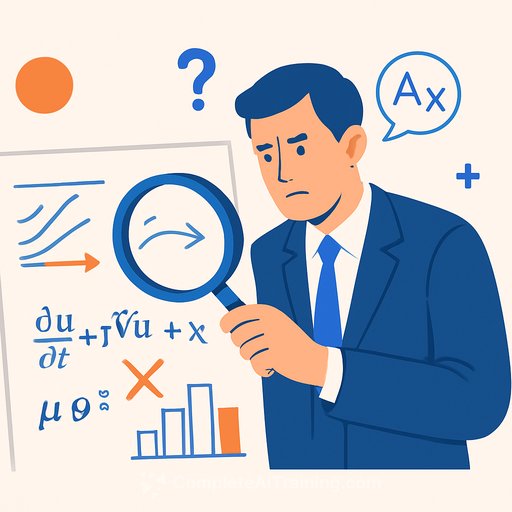
OpenAI claims it has produced a proof for the Navier-Stokes equations, one of the most famous unsolved problems in mathematics, but the announcement has drawn immediate pushback from mathematicians and physicists who say the work is not properly translated for human verification. The Clay Mathematics Institute lists a correct solution to the existence and smoothness problem for these fluid dynamics equations among its Millennium Prize Problems, with a $1 million reward attached.
The Navier-Stokes equations are partial differential equations that model how fluids like water and air flow. For more than a century, proving that smooth solutions always exist under all conditions has remained an open challenge. OpenAI's approach used machine learning techniques to construct a formal proof, but the presentation has become the central point of dispute.
Where the proof falls short for human reviewers
Critics point to the proof's reliance on automated theorem provers and what they describe as opaque intermediate steps. Several experts said the work contains logical gaps that are difficult to identify because the notation and reasoning do not follow standard mathematical conventions. The core objection is not necessarily about whether the proof is wrong, but whether it can be properly evaluated at all in its current form.
The debate echoes longer-running tensions about the role of AI in pure mathematics. Automated systems can generate and check vast chains of reasoning, but the field has always demanded that proofs be readable, shareable, and verifiable by human experts. A proof that only a machine can check does not meet that bar for many in the community.
OpenAI's response and next steps
OpenAI maintains the proof is sound. The company characterized the criticism as a matter of communication rather than correctness. In a statement, it said it will release additional documentation and tools to make the proof more accessible for peer review. Whether those materials satisfy the objections remains to be seen.
Why this matters for researchers and writers
For scientists and technical writers, this incident sharpens a question that will recur as AI tools enter more research domains: who is responsible for making machine-generated output interpretable? A proof, a legal argument, or a research finding carries weight only if its reasoning can be inspected. The standards that apply to human authors are not being lowered, and professionals who use AI in their work should expect the same demand for clarity and traceability. Those building skills in this area may find relevant coursework through AI for Scientists Courses and AI Research Courses, which address the intersection of machine reasoning and professional standards.