
AI news ·
Oxford and DeepMind study finds post-training narrows LLM worldviews
A 51-page Oxford and Google DeepMind study found post-training systematically narrows how eight frontier AI models represent the world. Longer conversations partially restore that lost breadth, but the effect was inconsistent across models.
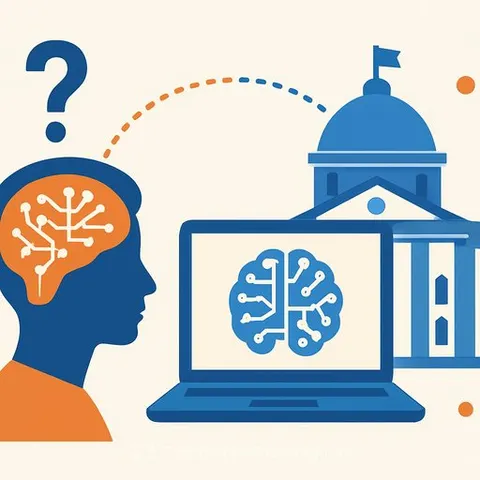
A 51-page study from Oxford University and Google DeepMind tested eight frontier AI models and found that post-training - the fine-tuning phase after initial training - systematically narrows how models represent the world. Long, open-ended conversations can partially restore that breadth. The paper, published November 22 on arXiv (2611.22670), examined models including Claude Sonnet 4.5 and Claude Opus 5.
The research identifies a tension in how large language models are built. Pre-training exposes models to vast, diverse data, giving them broad "worldviews." Post-training, which aligns models to be helpful and safe, collapses that diversity into a narrower set of acceptable outputs. The study calls this effect "the bleakness of the post-trained mind."
What the study measured
Researchers quantified worldview diversity by probing models across multiple dimensions - political orientation, moral reasoning, cultural knowledge, and factual beliefs. They compared base models (pre-trained only) against their post-trained versions. Across all eight models tested, post-training reduced variance in responses. Models converged toward similar answers on controversial topics, even when the underlying pre-trained models had shown genuine disagreement.
The paper found that longer dialogues - conversations extending over many turns - partially reversed this effect. As exchanges grew, models drifted away from their post-trained alignment and toward the broader distribution seen in base models. The authors describe this as a "healing" of worldview diversity through sustained interaction.
Why post-training has this effect
Post-training typically uses reinforcement learning from human feedback (RLHF) or similar techniques. Human raters score model outputs, and the model learns to produce responses raters prefer. The study argues this process rewards conformity. Raters tend to agree on what looks "safe" or "helpful," so models learn to give the least controversial answer - not the most representative one.
The result is a model that performs well on benchmarks but holds a compressed, homogenous picture of the world. For professionals who rely on these models for research, writing, or analysis, that compression can mean missing perspectives the base model would have surfaced.
What the findings don't say
The paper does not argue that post-training is harmful or should be removed. Alignment remains essential for safety - base models can produce toxic, dangerous, or manipulative content. The authors frame the narrowing as a tradeoff, not a failure. The question is how to preserve more of the pre-trained model's breadth while still making it safe to deploy.
Nor does the study claim that long dialogues are a practical fix. The "healing" effect was partial and inconsistent across models. Some worldviews remained suppressed regardless of conversation length.
Why this matters for writers and researchers
If you use AI models for drafting, ideation, or analysis, the study offers a concrete warning: the model you're talking to represents a deliberately narrowed slice of what it knows. For writers, this can mean flattened prose and predictable arguments. For researchers, it can mean missing outlier hypotheses or minority viewpoints that the base model would have considered.
For HR and communications professionals, the findings raise questions about bias auditing. If post-training systematically suppresses certain worldviews, then fairness evaluations that only test the deployed model may miss what was removed during alignment. The study suggests auditing should compare base and post-trained versions, not just the final product. Professionals working with these systems can explore this dynamic further through Generative AI Courses or AI Research Courses that cover model behavior and evaluation.