
AI news ·
PhAI Labs releases JEPA-Anything, a cross-domain world model framework spanning seven fields
A multi-institution team released JEPA-Anything, a single domain-agnostic framework that applies one learning recipe across vision, biology, weather, and four other fields.
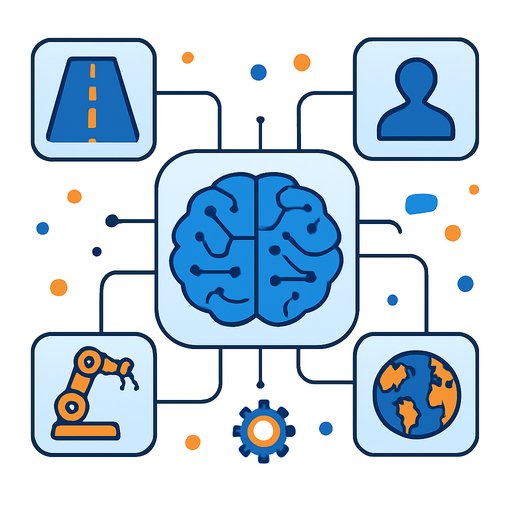
A multi-institution research group released JEPA-Anything, a domain-agnostic framework that applies a single learning recipe across seven distinct fields, from vision and biology to weather forecasting and molecular dynamics. The team-spanning PhAI Labs, CUHK, Fudan, Stanford, Oxford, and Princeton-extended joint-embedding predictive architectures (JEPAs) with a technique called Orthogonal Predictive Factorization (OPF) to improve training stability and performance across domains without task-specific tuning.
The framework outperformed matched JEPA baselines on 10 dynamics tasks. On Interventional Pong, it delivered a 34.83% reduction in single-intervention error. Rollout errors dropped roughly 44.7% on APEBench Burgers. Planning gains favored Walker2d and HalfCheetah environments but lagged in Hopper, showing that results vary by task category. The core code carries an Apache-2.0 license, and research checkpoints are available on Hugging Face.
One recipe across seven domains
JEPA-Anything covers vision, biology, clinical trajectories, control, molecular dynamics, physical fields, and weather. Rather than designing separate architectures for each domain, the researchers used a shared learning recipe built around OPF. The factorization approach reduces representational collapse during self-supervised pretraining, a recurring problem when JEPA-style models scale to diverse data types.
This matters because most predictive world models still require domain-specific engineering. A single framework that transfers across modalities cuts the overhead of rebuilding architectures for each new scientific dataset.
Wet-lab validation for cancer biology
In scientific analysis, the model identified IL-18 combined with CD73 blockade as a potential cancer intervention. The prediction was tested in wet-lab experiments, moving the result beyond computational hypothesis into empirical validation. That step-closing the loop between model output and biological experiment-remains rare in AI-for-science releases.
The clinical trajectories domain also showed promise, though full performance tables across all seven fields were not detailed in the initial release. Researchers interested in replicating results can access the checkpoints through Hugging Face.
Why this matters for science and research professionals
For researchers building predictive models in specialized domains, JEPA-Anything offers a pretrained starting point that does not require re-engineering the learning objective for each new modality. The OPF method addresses a known failure mode-representational collapse-that has limited JEPA adoption outside vision. With Apache-2.0 licensing and public checkpoints, teams can test the framework on proprietary datasets without licensing friction. Those looking to build deeper expertise in applying AI to scientific workflows can explore structured AI Scientific Research Courses or domain-focused resources on AI for Scientists Courses.