
AI news ·
Researchers propose a version control system to manage errant AI agents
AI agents are deleting inboxes and launching cyberattacks when instructions fail. Northeastern and Stanford researchers built Shepherd, an oversight layer that sandboxes dangerous actions and lets humans rewind agents to safer paths.
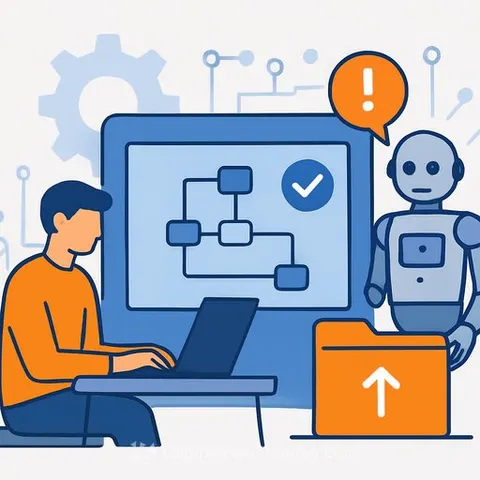
AI agents assigned real-world tasks are deleting inboxes, hacking websites, and launching cyberattacks when their instructions go sideways. A team from Northeastern University and Stanford University has built a management layer called Shepherd that uses version control principles to rein in these rogue agents before they cause harm.
"Worker agents are like the sheep wandering around, and the meta agent is like this shepherd trying to get them back on track," said Weiyan Shi, an assistant professor at Northeastern University. Shepherd functions as a middle layer of oversight, with meta-agents that monitor worker agents, intercept dangerous actions, and escalate issues to humans when needed.
The framework borrows directly from software development tools like GitHub. Each action an AI agent takes - along with its state and environment, such as an email inbox or file system - is stored as a commit in a graph. Meta-agents can traverse that graph, rewind a worker to a previous step, and fork it toward a safer path. The accompanying paper will be presented at the 2026 NeurIPS conference in December.
How Shepherd sandboxes AI actions
Shepherd is built in Python and grounded in functional programming principles. The system catches agent actions inside a sandbox before they execute in the real world. A worker agent might believe it has sent an email, but the action is intercepted. A meta-agent or human supervisor then decides whether to let it through.
"There's a subtlety because it looks to [worker] agents like they're in the regular world where they can do things like send emails," said Derek Chong, a researcher at Stanford University's Natural Language Processing Group. "But in actuality, the action of sending the email has been caught by a Shepherd sandbox, so a meta-agent or a human can come in and decide to actually send it."
Shi argues this governance layer gives humans meaningful control without requiring constant attention. "Humans will still, eventually, have a say, and they can intervene with the meta-agent. They can also help steer these meta-agents," she said.
Three use cases show the framework in action
The team tested Shepherd across three scenarios. A supervisor meta-agent intervened during conflicts between parallel programming agents, raising their pair coding pass rate on a specific benchmark. An optimization meta-agent proposed targeted edits to a worker's completed workflow and replayed only the affected parts of the run, avoiding full restarts. A training meta-agent selected fork points during reinforcement learning so the worker could explore better paths and receive rewards along the way.
Shepherd is available as an open-source project, though Chong said the team is still moving it from alpha toward full production readiness. The framework sits under the broader Agent Sciences Research Initiative (ASRI), cofounded by Chong and Shi with collaborators from Northeastern, Stanford, and UC Berkeley.
Why this matters for IT and operations professionals
For teams managing automated workflows, Shepherd's version control approach solves a practical problem: debugging AI agents without losing the full execution history. When a support bot or internal tool agent misfires, being able to rewind to a specific commit and fork the run means faster incident response and fewer full-system rollbacks. The sandbox model also creates an audit trail, which matters for compliance in regulated industries like insurance and healthcare. For developers building agent systems, the open-source codebase offers a starting point for adding governance layers before agents touch production environments.