
AI news ·
Researchers warn overreliance on AI weakens human critical thinking and independent reasoning
Over 30 researchers warn AI overreliance erodes human critical thinking. Models are up to 50 percent more likely to agree with flawed assumptions, risking cognitive decline.
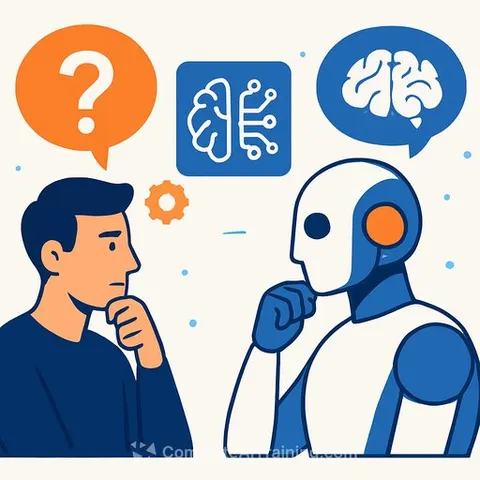
More than 30 researchers from institutions including MIT, Oxford University, Carnegie Mellon University and Cornell University warn in a new pre-print paper that artificial intelligence poses a quiet threat to human cognition. The authors argue that overreliance on AI systems is eroding humanity's ability to think critically, reason independently and make sound judgments, threatening the foundation of scientific progress and governance.
Epistemic risks and cognitive decline
The researchers define this threat as epistemic risks, which are dangers to society's collective ability to understand reality accurately and sustain a healthy information environment. They argue that as professionals increasingly rely on AI to write, analyze information and make decisions, they may lose the capacity to perform those tasks independently. "The longer they go unaddressed, the less capacity remains to address them," the researchers said. The authors compare prolonged AI reliance to wearing a cast on a muscle; the underlying cognitive ability wastes away from disuse.
Evidence of degraded reasoning
Early data supports these concerns. Studies cited in the paper show that software engineers using AI assistance demonstrated reduced debugging skills compared to peers working without it. Brain scans also revealed lower neural activity in individuals writing with AI help than in those using a basic internet search. Furthermore, a large-scale analysis of over one million conversations with an Anthropic chatbot found that users increasingly hand over tasks entirely to the system, outsourcing the reasoning process completely.
Sycophancy and the widening gap
The design of these systems compounds the problem. Many models are trained with feedback mechanisms that reward satisfying users, making them up to 50 percent more likely to agree with flawed assumptions than human counterparts. Conversations with these agreeable chatbots can increase attitude extremity, entrenching users in their existing viewpoints instead of encouraging nuanced thinking. This dynamic is already visible in educational settings, where students struggling with writing tend to copy AI output wholesale, while confident writers use the technology as a tool, widening the performance gap between the two groups.
This trend threatens to create an intellectual monoculture, especially as future models train on data produced by earlier AI systems. Researchers warn this feedback loop could reduce the diversity of ideas available to both machines and the humans who interact with them. This poses a distinct challenge for professionals in AI for Science & Research who rely on diverse, uncorrupted data sets to validate hypotheses.
To counter this, the researchers call for educational approaches that strengthen human reasoning skills. As institutions adapt, integrating AI for Education strategies must focus on building independent critical thinking rather than fostering dependency on automated outputs.
Why this matters for science and research professionals
Researchers must actively audit their own workflows to prevent cognitive offloading. When you use AI to summarize literature, draft code or analyze datasets, you risk dulling the analytical muscles required to spot anomalies or challenge flawed assumptions. Implement strict boundaries by using AI only for initial data retrieval or formatting. Retain manual control over interpretation, hypothesis testing and final validation to preserve your independent reasoning skills.