
AI news ·
Rural hospitals use artificial intelligence to modernize radiology and protect against consolidation
Rural hospitals can avoid private equity buyouts by adding AI to radiology. The tech catches the 40-60% of missed follow-ups and cuts denials to restore revenue.
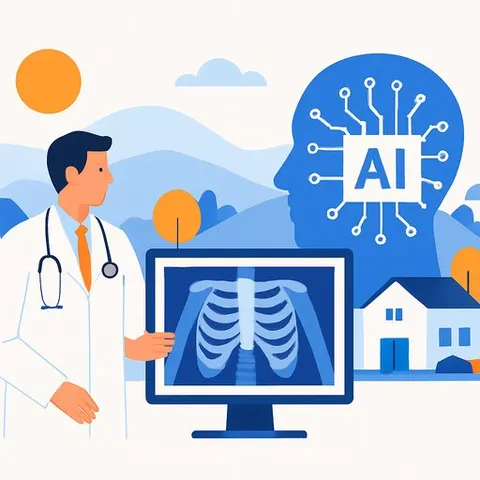
Rural radiology departments are caught between rising patient volumes, flat staffing, and the growing threat of consolidation by private equity firms. Dr. Anand "Dr. A" Lalaji, CEO of The Radiology Group, argues that the only path to survival is to treat the radiology department as a profit center and add AI-assisted workflows that keep human decision-making at the center.
Cost-cutting consolidators and the loss of local radiologists
The traditional model-a local radiologist who knew both the hospital team and the patients-is eroding as those radiologists retire. Large consolidators step in with aggressive cost-containment strategies that often hurt the community, Lalaji said. "Private equity and large consolidators merge radiology practices or imaging centers," he said. "There's another category of private equity buying distressed, rural hospitals. Once that happens, they become very aggressive in cost containment measures. Half those strategies harm the community."
Maintaining the status quo while AI advances will only make it harder to catch up later, Lalaji said. He recommends that rural hospitals modernize their radiology departments now to protect their independence and restore revenue. "They can use AI to make radiologists more efficient and to restore revenue on the balance sheet," he said. "If they do that, they can protect themselves against consolidators."
Communication, cost containment, and consistency
The Radiology Group's service model focuses on three areas. For communication, the DocsInk platform enables efficient, HIPAA-compliant messaging between clinicians, radiologists, and hospital staff, replacing disjointed phone calls, texts, and emails. The group also visits hospital partners at least every six months to troubleshoot and strategize in person.
Cost containment gets a boost from www.Inflohealth.com, which uses AI to read radiology reports and flag suspicious findings. The system then prompts the radiologist on the appropriate follow-up, helping to address the 40-60% of follow-ups that typically get missed in the findings section. AI also identifies denial codes so staff can fight insurers who try to reject legitimate claims, generating savings that can be reinvested into the hospital and emergency department.
Combining AI with human oversight has also led to greater consistency in report reading and faster turnaround times. A rapid response team monitors every communication from every hospital 24/7, and all interactions are documented. "Everything is documented, so every problem can be solved easily," Lalaji said.
AI in the workflow and quality assurance
Radiology technician shortages are well documented, and rural hospitals often can't staff enough specialists daily. AI can help fill that gap. For a routine ultrasound, a medical assistant can scan the abdomen, and the ultrasound machine uses AI to consolidate images, read them, and send results to a remote tech who approves and forwards them to the radiologist. This prevents overload on a short-staffed team.
The Radiology Group also monitors remote radiologists to maintain quality. If a radiologist starts reading too fast, the AI-based platform prompts them to slow down. The group's proactive quality assurance program randomly selects studies for oversight; if the case looks good, the team does not intervene. The push to adopt AI for Healthcare is not about replacing people but giving them the tools to work more reliably.
Five priorities for rural hospital administrators
Lalaji offers a clear set of priorities for hospitals that want to position their radiology departments for future success:
- Change your mentality. Accept that the market is double the cost of six to eight years ago and that the shortage of radiology professionals is real. Stop chasing cheap services and instead incentivize the radiology director to grow the department.
- Take inventory. Nearly 80% of hospitals have unused equipment. Determine what you can use and sell the rest.
- Employ a radiology group run by radiologists. A group owned by private equity will give the hospital less attention. The radiologist must be the subject matter expert of the department to ensure longevity and financial viability.
"The world will look very different every year in terms of what the radiologist and radiology department looks like," Lalaji said. "It is important that hospitals stay on the frontline of that trend by including their subject matter expert in their decision-making."
Why this matters for healthcare professionals
For radiology administrators and department directors, the message is that ignoring AI and sticking with outdated workflows will widen the gap between independent rural hospitals and well-funded consolidators. The steps outlined here-making radiology a profit center, using AI to catch missed follow-ups and denial codes, and keeping a radiologist-led group in charge-are concrete levers that can be pulled without waiting for a perfect budget or staffing miracle. The data from the group's rapid response and volume spike predictor shows that even small operational changes, like 60 minutes of lead time for resource allocation, can shift the department's financial trajectory.