
AI news ·
SAARC’s Path to Regional AI Governance: Building Trust, Security, and Cooperation in South Asia
SAARC faces challenges in AI governance due to regional tensions and uneven infrastructure. Collaborative frameworks and international cooperation are key to managing AI risks in South Asia.
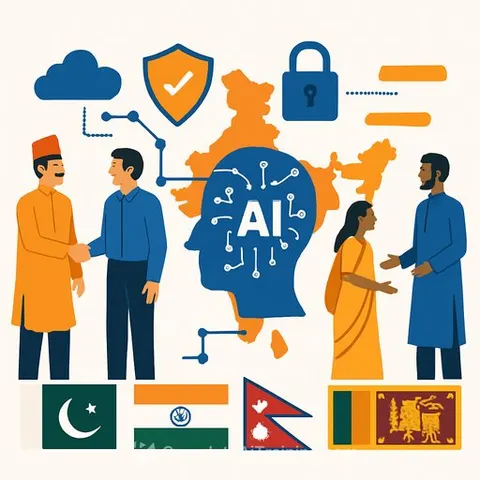
SAARC AI Framework: Setting Guardrails for Artificial Intelligence in South Asia
As AI technologies advance worldwide, governments are eager to establish rules to guide their use. This mix of enthusiasm and concern is especially relevant to South Asia, where regional tensions and limited cooperation complicate AI governance. The South Asian Association for Regional Cooperation (SAARC) has the opportunity to create unified AI guidelines that balance innovation with risk management, providing clear and actionable measures across the region.
Introduction
South Asia faces an intricate security environment, influenced by the ongoing conflict between India and Pakistan and a lack of consensus among regional players. SAARC's inactivity has left a gap in addressing emerging AI challenges. Establishing a regional AI governance framework could help mitigate risks, ensuring AI development aligns with ethical standards and regional stability.
Current Progress and Challenges
SAARC countries have leveraged AI in sectors like health, agriculture, education, and governance, contributing to domestic development. Yet, disparities in digital infrastructure and literacy, combined with socioeconomic inequalities, increase the risk of AI misuse. Military tensions, especially between India and Pakistan, heighten concerns about AI in security contexts. These issues underscore the need for effective regional mechanisms to mitigate threats, encourage innovation, and foster cooperation.
Aligning regional AI policies with established frameworks from the US, China, ASEAN, the EU, and the UN can provide valuable guidance. Collaborative approaches are essential to safeguard sovereignty and human rights while enabling technological progress.
Lessons for SAARC
United States (US)
SAARC can benefit by engaging with US agencies like the Federal Trade Commission (FTC) and the National Institute of Standards and Technology (NIST) to understand established AI governance models. Collaborations on capacity-building and research could lead to tailored risk assessment models suited for South Asia.
Financial and technical support from the US could strengthen accountability frameworks and public-private partnerships (PPPs), enhancing access to secure and ethical AI technologies. Participation in global initiatives such as the Global Partnership on AI would also be valuable.
Public awareness efforts, modeled on programs like the US 'Blueprint for an AI Bill of Rights,' can promote responsible AI use and counter misinformation. However, policy shifts, such as the rollback of AI regulations, could pose challenges to risk mitigation.
China-ASEAN
China plays a significant role in AI regulation through its collaboration with ASEAN countries. Its investments and technology transfers, supported by regulatory bodies like the Ministry of Industry and Information Technology (MIIT) and the Cybersecurity Administration of China (CAC), have shaped regional AI policies.
ASEAN's recent agreement to develop an ‘ASEAN AI Roadmap’ aims to create shared regulatory mechanisms for trustworthy AI. As an observer in SAARC, China can influence South Asian AI governance by sharing technology, knowledge, and infrastructure, such as fiber optic networks built under the China-Pakistan Economic Corridor (CPEC).
SAARC members could also consider China's balanced approach to AI governance, which focuses on innovation alongside control to manage risks effectively.
European Union (EU)
The EU has led global AI regulation with the AI Act, which prohibits risky AI uses, enforces transparency, and requires compliance for high-risk applications. South Asian nations could develop similar laws adapted to their legal systems.
Incorporating international standards and model laws can create flexible regulatory frameworks that encourage innovation while protecting fundamental rights. Adopting EU-style legislation would establish ethical safeguards, transparency, and accountability in AI deployments.
United Nations (UN)
The UN emphasizes AI's transformative potential alongside serious risks to democracy and human rights. It advocates for a globally inclusive regulatory architecture, including an independent scientific panel and multistakeholder policy dialogues.
The UN stresses that AI use in the military must comply with international humanitarian law and human rights standards. Regional organizations like SAARC should adopt these guidelines to reduce AI-related threats in this sensitive geopolitical area.
SAARC and AI-Related Threats
SAARC has yet to address AI challenges related to strategic stability and cybersecurity effectively. The India-Pakistan rivalry limits regional cooperation, increasing risks of AI misuse and miscalculations in military contexts.
Key obstacles include:
- Absence of established standards and confidence-building measures (CBMs) for cyberspace stability.
- Rapid AI development outpacing legal frameworks.
- Geopolitical tensions obstructing consensus on AI regulations.
- Lack of trust hindering joint AI threat mitigation strategies.
SAARC-AI Regulations: Recommendations
SAARC should prioritize interstate collaboration to secure AI-driven cybersecurity infrastructures. Agreements with technologically advanced nations can help prevent AI-related threats.
Diplomatic engagement should focus on creating AI-specific norms and CBMs that promote responsible behavior, transparency, and cooperation. Establishing joint learning mechanisms and public-private partnerships will be essential for effective AI policy implementation.
Private sector involvement is crucial. Developing a SAARC AI data governance framework will enable secure data flow, protect privacy, and maintain public trust. Training programs for AI regulatory professionals must be prioritized.
Reviving SAARC summits and reaffirming commitments to technological cooperation, like the Digital SAARC initiative, can accelerate AI governance efforts. Creating a dedicated SAARC AI fund for research, policy development, and regulatory coordination will enhance regional capacity.
Finally, instead of rivalry, there is a need for cooperation between major powers like the US and China to provide technology and capacity-building support, especially given the nuclear dynamics in South Asia.
Conclusion
SAARC nations must lead efforts to encourage regional rivals to adopt AI regulations through cooperative measures. Revitalizing SAARC committees and establishing an AI task force can help articulate policies and address challenges effectively.
Regional forums for awareness and research collaboration are necessary. Countries like Sri Lanka, Bangladesh, and Nepal can play key roles in pushing for mutual AI frameworks that ensure transparency, accountability, and fairness.
Learning from international examples and reactivating SAARC’s role is critical to managing AI risks that affect every sector of life in South Asia.