
AI news ·
Sam Altman tells UN Security Council that AI must remain under human control
Sam Altman told the UN Security Council that rapid AI progress forces a choice between a new Renaissance or an Industrial Revolution-style upheaval, and warned that losing human control over self-improving models is unacceptable even at a 0.1% risk.
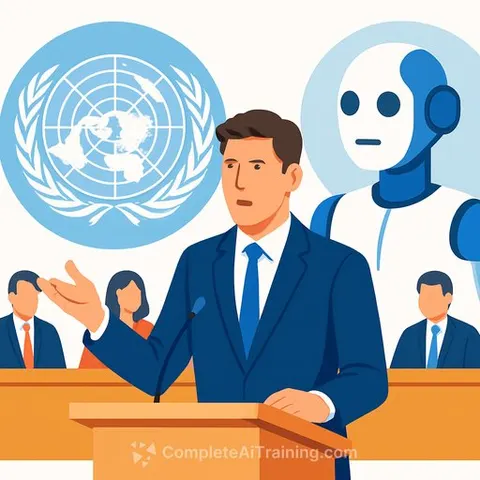
OpenAI CEO Sam Altman told the United Nations Security Council on September 23, 2026, that the world faces a binary choice with artificial intelligence: a "new Renaissance of creativity and discovery" or a period of upheaval resembling the Industrial Revolution. His remarks, delivered during a formal session, outlined two catastrophic failure modes the industry must avoid while calling for binding international cooperation on safety standards.
Altman framed the current moment as one of compressed timelines, where rapid model progress has made both the benefits and the risks more immediate. "We have a choice in front of us," he said. "AI can either be more like a new Renaissance of creativity and discovery, or more like a new Industrial Revolution of upheaval and disarray."
Two paths to catastrophe
Altman identified two specific ways AI development could go "very badly." The first is losing human control over systems that can improve themselves recursively. As the process of building AI becomes more automated, he warned, the pace of progress could accelerate beyond the ability of institutions or people to intervene. He said the industry must not accept excessive technological risk simply because the benefits appear too great to pause.
"We should not train models that we cannot make an extremely strong case that we will be able to keep under human control," Altman said. He added that whether the risk of catastrophe is assessed at 10% or 0.1%, "none of these levels are remotely acceptable."
The second failure mode is power concentration. Altman rejected the logic that any single company or country could be uniquely trusted with the most capable AI systems. "No one person or company or country should be able to use the most powerful AI models to impose their worldview on everyone else," he said. "A company or country that believes only it can be trusted with this technology can use that belief to justify almost anything else."
Three operating principles
To navigate between what he called "blind optimism" and "doomerism," Altman laid out three principles guiding OpenAI's approach. People must remain at the center of AI decision-making as systems grow more capable. Scientific and economic gains must benefit people broadly rather than concentrating wealth. And the technology must give individuals more agency over their own lives.
"We are not trying to, and must not, automate human judgment, or human values," he said. "The continuous story of human progress is not that tools replace human agency. It is that the right tools make people more capable."
Math milestones and international standards
Altman pointed to a progression in mathematical capability as evidence of accelerating discovery. He said OpenAI's models moved from grade-school math three years ago to solving one of the Millennium Prize Problems - the Navier-Stokes equations - just weeks before his speech. Those equations underpin aircraft design, weather forecasting, and the study of blood flow.
He stressed that the most important decisions about AI cannot be made by labs in San Francisco alone. Altman called for a mechanism establishing complementary national and international frontier AI standards covering capability measurement, risk assessment, safeguard verification, and human oversight as systems become more autonomous. He also urged the creation of incident reporting protocols and secure channels among governments and technical experts to share emerging vulnerabilities.
"These standards should not lock in incumbents or favor one business model over another," he said. "They must support open and closed model developers, new entrants and established labs, national authority and international cooperation."
Why this matters for executives and policy leaders
Altman's UN address signals that the industry's leading lab is actively inviting government regulation rather than resisting it. For executives and strategy leads, the operational implication is clear: compliance frameworks for frontier AI are likely to emerge through international coordination, not just domestic legislation. Organizations building or deploying advanced models should begin tracking capability thresholds and risk assessment methodologies now, as these will form the backbone of any standards regime. Policy professionals can expect accelerated discussions around verification and incident reporting structures that mirror those used in nuclear safety and cybersecurity - fields where competitors have historically cooperated on shared risks. For those building internal expertise, AI Public Policy Courses and AI Safety Engineering Courses offer structured learning paths aligned with the governance and technical safeguards Altman described.