
AI news ·
SpaceX launches Google AI chips into orbit on Falcon 9 rocket
SpaceX launched Google's Project Suncatcher satellite on October 1 to test TPU AI chips in orbit. Google estimates Starship would need about 1,600 launches before orbital data centers become economically viable.
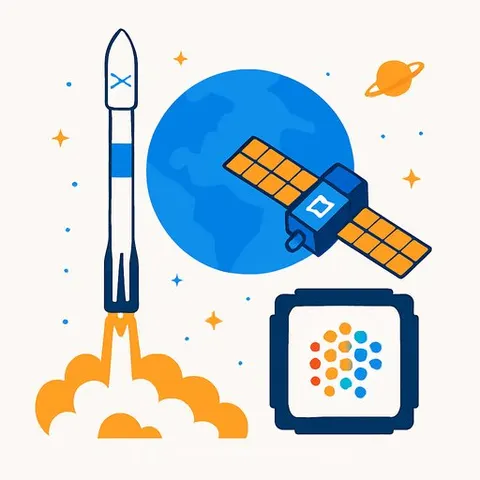
SpaceX launched a Falcon 9 rocket carrying Google's Project Suncatcher satellite into low-Earth orbit on October 1 as part of the Transporter-18 rideshare mission from Vandenberg Space Force Base. The satellite carries Tensor Processing Units (TPUs), Google's custom AI accelerator chips, to test how they perform under radiation and thermal conditions in space. The mission is a first step toward Google's longer-term goal of building orbital data centers.
What the satellite is testing
Project Suncatcher is a prototype designed to evaluate whether commercial AI hardware can survive and operate reliably outside Earth's atmosphere. The TPUs aboard the satellite will be monitored for performance degradation caused by cosmic radiation and extreme temperature swings. Data from the experiment will inform whether Google can scale the approach to larger orbital facilities.
The launch carried 130 payloads in total, including the Google satellite. Rideshare missions like Transporter-18 bundle multiple small payloads onto a single Falcon 9, reducing launch costs for individual customers.
The orbital data center bet
Google has said that space-based data centers could eventually address constraints on terrestrial computing capacity, including power availability and cooling requirements. But the company has also acknowledged the scale of the challenge. According to reporting from TechCrunch, Google estimates that SpaceX's Starship would need to launch roughly 1,600 times before orbital data centers become economically viable.
That figure underscores the gap between a single prototype satellite and a functioning off-world computing infrastructure. The Suncatcher mission is an early hardware validation step, not a commercial deployment.
Industry context
The launch places Google among a small group of companies exploring space-based computing. The test follows a September announcement that the Suncatcher satellite would fly on Transporter-18, and it comes as demand for AI compute continues to strain terrestrial data center capacity. Competitors and partners across the space and cloud sectors are watching the results closely.
Why this matters for AI and research professionals
The Suncatcher mission tests a specific hardware question: whether TPUs can maintain compute integrity under sustained radiation exposure without the shielding available on Earth. For researchers working on AI infrastructure, the results could shape assumptions about hardware reliability in extreme environments and inform long-term planning for distributed compute architectures. The experiment also signals that major cloud providers are investing in physical prototypes rather than white papers when evaluating unconventional data center strategies.