
AI news ·
Springer Nature retracts AI review article for undeclared generative AI use
A Springer Nature journal retracted a 2024 review after finding the authors used generative AI without disclosure, citing fabricated references as key evidence. One author objected to the retraction, which can affect funding, tenure, and reputation.
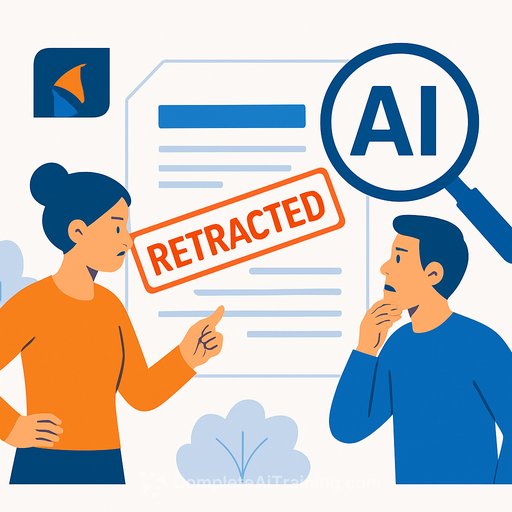
A Springer Nature journal has retracted a 2024 review article after an investigation found the authors used generative AI in the manuscript without declaring it. The retraction, dated October 3, 2026, targets a paper in Discover Artificial Intelligence written by Muhammad Asif and Zhou Gouqing of Hunan Normal University. The discovery of fabricated, contextually incorrect references triggered the publisher's probe, highlighting the growing scrutiny on undisclosed AI use in academic publishing.
The evidence that triggered the investigation
The article was first published on May 16, 2024. Springer Nature cited contextually incorrect references as the primary evidence of undeclared AI use. Such errors, often called "hallucinations" in large language model outputs, produce citations that look plausible but refer to papers that do not exist or are unrelated to the cited content. The publisher did not detail the specific references in question but determined they were sufficient grounds for retraction.
When contacted by the journal, the authors did not provide a satisfactory explanation for the errors. Muhammad Asif objected to the retraction, while Zhou Gouqing did not respond to the publisher's communications.
The policy on generative AI in scholarly work
Springer Nature's editorial policies require authors to disclose any use of generative AI technologies in their manuscripts. The policy does not ban AI tools outright but mandates transparency about their role in the writing or research process. Undeclared use constitutes a breach of publication ethics.
This retraction arrives as academic publishers grapple with a surge of AI-generated submissions. The ease of producing plausible-sounding text with tools like ChatGPT has created new challenges for peer review and editorial oversight. Publishers are increasingly deploying AI detection tools and tightening authorship guidelines to preserve the integrity of the scientific record.
Why this matters for researchers and writers
For researchers, the retraction is a clear signal that undisclosed AI use carries career consequences. A retraction on a researcher's record can affect funding, tenure, and professional reputation. The episode underscores that disclosure is not optional-it is a condition of publication.
For writers and editors working in scientific communication, the incident reinforces the need to verify every reference against primary sources. Generative AI can accelerate literature reviews and drafting, but its outputs require the same rigorous fact-checking as human-written text. Professionals responsible for manuscript preparation should build verification steps into their workflow, particularly when reviewing citations and factual claims produced by language models.