
AI news ·
Study finds four distinct manager profiles behind AI adoption gap
Only 7% of managers are true AI believers; 42% are pragmatic adopters, 41% strategists, and 10% skeptics, per a study of 472 U.S. marketing managers. Effective AI adoption requires tailored support for each profile, not blanket mandates.
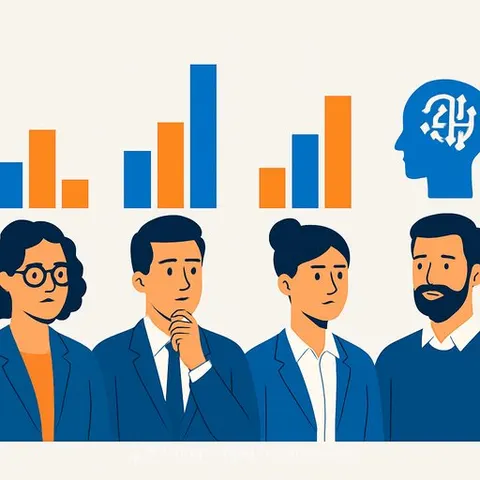
Leadership meetings are full of agreement that artificial intelligence matters. Walk out of the room, and that consensus falls apart. One manager runs every decision through an AI assistant. Another uses AI only to draft emails. A third avoids it entirely, worried about quality and jobs.
New research suggests this is not a training or compliance problem. Managers differ not simply in how much they use AI, but in how they fundamentally understand what it means to collaborate with it. A study published in Technovation, based on a survey of 472 marketing managers in the United States, identified four distinct psychological profiles toward AI. Only 7% of managers are true believers. Leaders that can recognize each mindset are far better positioned to integrate AI quickly and durably than those relying on top-down adoption mandates.
Four psychological profiles, one fragmented workforce
The researchers classified managers by how they use AI - whether they apply it to deepen expertise within their own domain, bring insights from other business functions, or integrate AI output into how their teams make decisions. They then combined that with each manager's sense of control over AI, their trust in its transparency, organizational support for experimentation, and willingness to hand decision authority to algorithms.
AI Trailblazers make up just 7% of managers. They treat AI as a genuine strategic partner, use it across functions, and feel firmly in control. This is the only group willing to make a substantial shift in decision authority, trusting AI in nearly half of their decisions. They which report the highest satisfaction with market performance, and their organizations actively encourage experimentation.
AI Strategists are the 41% of managers who value AI highly but use it always within a governance frame. "AI speeds up decision-making dramatically, but always as part of a process where humans lead," one Strategist told researchers. They prefer structured, incremental expansion over bold leaps.
Pragmatic Adopters, the largest group at 42%, use AI where it demonstrably helps - analyzing data faster, drafting content, optimizing campaigns - but say its output needs human quality checks.
AI Skeptics account for 10% of managers. They see little value in AI, feel the least in control, and find it the least transparent. They express genuine unease about job displacement and the erosion of human creativity. They also work in the least AI-supportive organizations and report the lowest satisfaction with market performance.
Adoption rates are the wrong metric
Three findings give leaders reason to pause. First, the enthusiasts are rarer than most assume - just one manager in fifteen. More than 80% of management teams sit in the cautious middle, using AI selectively while insisting on human control. A strategy built on eager adoption of algorithms targets a group that barely exists.
Second, attitudes toward AI are not fundamentally about technology. The differentiators are psychological: felt control and perceived intelligibility. "Skeptics do not resist AI because they cannot operate it," the authors write. "They resist it because it feels opaque and beyond their influence." This suggests the cure is not more product training - it is more transparency and more genuine human agency in how AI is deployed.
Third, organizational climate tracks performance. Managers in organizations with a proactive stance toward AI - one that allows trying new ways of working with the technology - report significantly higher satisfaction with their market performance. The authors caution that they cannot claim simple causality, but the pattern is consistent.
One-size-fits-all AI programs fail most people
The research implies that blanket AI rollout schemes waste money on some managers and alienate others. Each profile needs a different approach.
Deploy Trailblazers as multipliers, not outliers. Give them room to run AI strategy pilots and formally assign them as mentors to other groups. Their enthusiasm is contagious, but only if channeled rather than left isolated - and their expectations may outrun what AI currently delivers, so their optimism needs an honest peer review.
Strategists want governance, not cheerleading. They will expand AI's role if guardrails are explicit: clear human oversight points in decision processes, scenario-based training on when to trust AI versus override it, and explanations tied to real business cases. Well-designed processes move them; slogans about "AI transformation" will not.
Pragmatic Adopterswin with proof, not vision. Show them concrete, task-level wins - campaign optimization, lead scoring, reporting automation - with dashboards that make AI's reasoning legible. Let each them control how much influence AI has. Each demonstrated win expands their comfort zone incrementally.
Skeptics should be taken seriously. Their fears about displacement and lost control are what responsible AI governance exists to address. Start them with low-stakes analyses, guarantee human-in-the-loop defaults and manual overrides, and pair them with trusted, AI-positive peers rather than label them as "the resistance." Their vigilance about data quality is a governance asset that unbridled enthusiasm lacks.
Why this matters for executives and strategy
The question moving forward is not whether managers will work with AI - it is on what terms. Those terms are being negotiated desk by desk, shaped into each manager's sense of control, understanding, and trust. For executives, the core strategic takeaway is the most efficient route to adoption is not mandating usage but curating the reality. Identify the four profiles in your own leadership team and intentionally design supports for each. Run experiments that feel safe for your skeptics. Give your strategists governance cadences. Turn your 7% percent of believers into a mentor that goes building, not a trophy case. The integration happens fastest where the relationship between human and AI comes before the mandate.
For further reading on building AI competence in leadership roles, see AI for Executives & Strategy and AI for Management.