
AI news ·
Taipei hospital VP urges clinicians to build their own AI agents
Taipei Veterans General Hospital's voice-based nurse documentation system cuts charting from minutes to seconds, saving about 1,200 hours daily across 80 nursing units. Roughly 70% of its AI programs are built in-house, with doctors governing the agents.
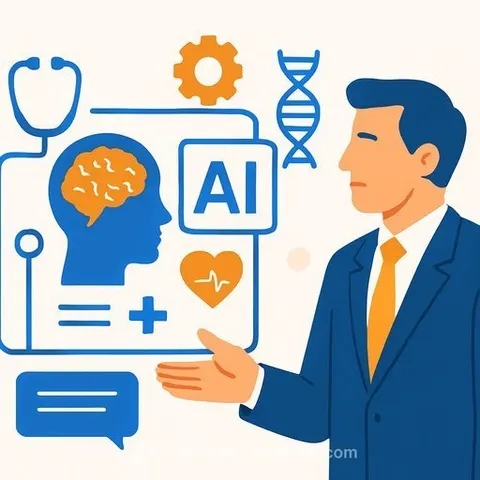
Taipei Veterans General Hospital (TVGH), a 3,000-bed facility serving about 10,000 outpatients daily, is moving beyond isolated AI tools toward a model where algorithms work in the background as "invisible teammates" for clinical staff. Dr Wui-Chiang Lee, the hospital's vice president, outlined this approach at the HIMSS26 APAC session, arguing that the next phase of hospital AI should let clinicians build and govern their own AI agents.
TVGH's AI work spans four decades, starting with bulky computer systems that built its data infrastructure. One recent project, a voice-based documentation system for nurses, has run across 80 nursing units for two years. Early results show nearly 70% of nurses would use it, cutting documentation time from minutes to seconds. The projected savings equal about 155 shifts per day, or roughly 1,200 hours.
Dr Lee said any AI programme must start with a clinical pain point, not with implementation for its own sake. "Whenever we introduce an AI model, I need to consider the impact of this AI on thousands of doctors and nurses and how it will influence millions of our patients."
About 70% of TVGH's AI programmes are built in-house by clinical and IT staff; the rest come from third-party providers. The hospital measures accuracy alongside workflow burden and keeps professional judgment in the loop. Staff training courses support continuous AI education.
From documentation to proactive orchestration
Healthcare AI adoption has shifted through several phases, Dr Lee said: from understanding to documentation, prediction to action, isolated deployments to integrated implementation, passive recording to proactive orchestration, and digitalisation to continuous learning. TVGH now describes its AI as a "proactive clinical teammate" that understands patient context, prioritises risk based on evidence, and coordinates across teams.
Dr Lee recommended prioritising low-risk AI tools over those with unrestricted autonomy. He envisions doctors designing their own small AI agents for tasks like pre- and postoperative patient evaluations, with physicians supervising and steering those agents. "Most importantly, these agents must be under the governance of the hospital."
The hospital's approach to developing AI in-house relates directly to broader AI for Healthcare training needs, as clinical staff must understand both the capabilities and limits of the systems they oversee. The shift toward clinician-governed agents also reflects the growing AI Agents & Automation trend across industries.
AI adoption is a human problem
"The adoption of AI is ultimately a human problem. It must start from the clinical pain point, not for implementation's sake," Dr Lee said. That principle shapes how TVGH evaluates its roughly 70 in-house AI programmes, measuring not just accuracy but also whether the tools reduce workload without removing professional oversight.
Why this matters for healthcare professionals
For clinicians and hospital administrators, TVGH's experience offers a concrete benchmark: voice documentation that saves about 1,200 hours across nursing shifts, in-house development for most AI tools, and a governance model where doctors supervise the agents they use. The practical takeaway is that AI programmes succeed when they solve a specific workflow problem, are measured on workload impact rather than accuracy alone, and keep clinical judgment as the final authority.