
AI news ·
Tesla faces production hurdles as workers push back on training humanoid robots to replace them
Tesla's Optimus robot still needs hand-built assembly of over 100 small components and task-specific programming, with the company targeting more than 1,000 units weekly by late 2026.
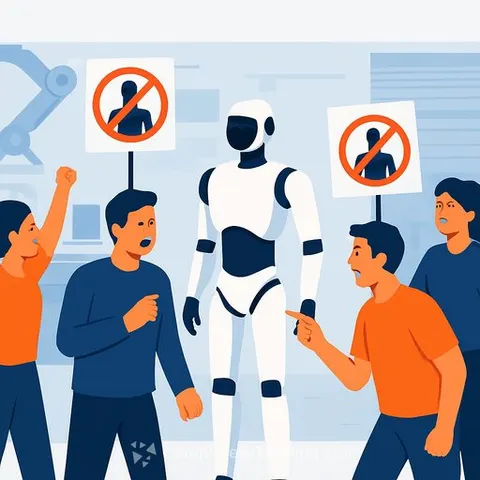
Elon Musk has called the Optimus humanoid robot potentially "the biggest product ever," but Tesla's pivot from electric vehicles to general-purpose robots is running into significant production and workforce hurdles. New reporting from The Information details complications ranging from unreliable touch sensors and manually assembled hands with over 100 small components to disgruntled factory workers pushing back against training their robotic replacements. The struggle to scale up comes as Tesla has already stopped making the Model S and Model X at its Fremont factory to redirect line workers and engineers to the Optimus program.
Production line headaches and hardware fixes
The newest version of the robot, Optimus V3, has proven difficult to manufacture at scale. Tesla has reportedly scaled up to hundreds of robots per week but is targeting more than 1,000 weekly by the end of 2026. Getting production line equipment to precisely line up components remains a problem, and the line cannot yet run at the speeds Tesla wants.
The robot's hands and forearms together contain more than 100 small components such as screws that require manual assembly by human workers. That labor-intensive process has led to newly produced robots needing immediate fixes. Touch sensors in the hands have been unreliable enough that Tesla developed a glove-like sensor layer that can be swapped out without replacing the entire hand.
AI limitations and training data pushback
The robot's AI capabilities are still insufficient for general-purpose operations. One source told The Information that Optimus robots currently require programming to do specific tasks in carefully controlled environments. This is a challenge shared across the robotics industry, where imitation learning demands vast amounts of training data showing humans performing physical tasks.
Tesla initially had factory workers in Texas and California wear special suits that recorded their movements. Some workers complained because they "knew the robots were designed to eventually replace them," The Information reported. Tesla has since shifted data collection to dedicated teams and set up training hubs for that purpose.
Supply chain dependence and global competition
Tesla continues to rely on Chinese suppliers for various robot components, a pattern that persists across the US robotics industry despite Trump administration efforts to boost domestic supply chains. In July, the Federal Communications Commission banned new foreign-made humanoid robots, four-legged robot dogs, and robot vacuum cleaners.
The competitive landscape is intensifying. Automakers in China, Japan, and South Korea are developing humanoid robots alongside dedicated robotics firms. Toyota plans to invest billions in factory upgrades using robots, including some humanoids. Hyundai intends to deploy up to 25,000 Atlas humanoid robots developed by its US subsidiary Boston Dynamics over the next several years. Oregon-based Agility Robotics was one of the first to achieve commercial deployment, putting robots to work at a GXO Logistics warehouse in Atlanta in 2024. Still, the broader business case for humanoid robots working safely and cost-effectively around people remains unproven.
Why this matters for executives and operations leaders
Tesla's production struggles highlight a hard truth about humanoid robots: the gap between a compelling demo and a reliable, scalable product is wide and expensive. For executives evaluating automation investments, the immediate lesson is that general-purpose humanoid robots are not yet a near-term workforce solution. The manual assembly, sensor reliability issues, and task-specific programming requirements mean these systems still demand significant human oversight. Leaders should track pilot deployments at companies like Agility Robotics and Boston Dynamics for realistic timelines, while investing now in AI Agent Courses and AI for Executives Courses to build the internal expertise needed to assess when and where robotic automation actually pencils out.