
AI news ·
Texas lawyer uses AI to win $6 million negligence case against Meta and Google
A Texas lawyer used supervised AI to win a $6 million negligence verdict against Meta and Google. Strict human oversight prevented the AI from fabricating citations.
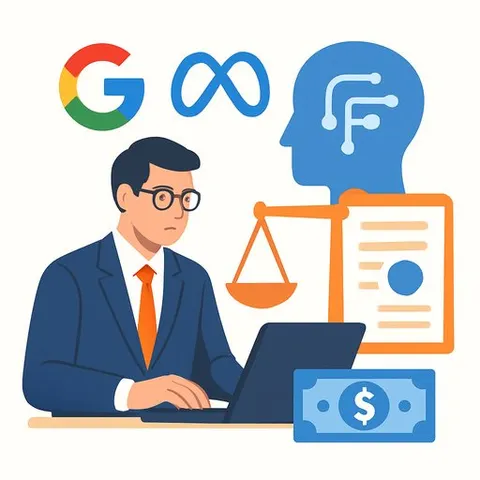
Texas lawyer Mark Lanier used artificial intelligence to prepare for and win a $6 million negligence verdict against Meta and Google, demonstrating how legal teams can deploy the technology under tight deadlines. The case highlights a growing divide in the courtroom between structured, supervised AI workflows and the unchecked use of tools that produce fabricated legal citations.
Streamlining trial preparation
Lanier deployed a customized, six-figure annual licensing agreement with Boodlebox, a collaborative platform that provides access to models like ChatGPT, Claude, and Gemini. His legal team used these Generative AI and LLM tools to analyze daily court transcripts, assess jury notes, and organize supporting evidence. Lanier oversaw the entire process, ensuring the technology remained an assistant rather than an autonomous decision-maker.
Lanier described the technology as a massive asset for his team during the high-stakes trial, comparing it to a staff of tireless paralegals. "It's as if I have 10 additional workers who are incredibly well-trained, who know the file inside and out, who work 24 hours a day and don't even need to take a break for the restroom, much less PTO," Lanier told Business Insider. "In the 10 hours I might be working outside of court, I can get 30 hours of work done."
The risk of AI hallucinations
A Mississippi court incident serves as a stark contrast to Lanier's supervised approach. A judge recently sanctioned four lawyers after they submitted AI-generated fake case citations in court filings. The judge canceled the trial and disqualified the attorneys involved.
Two of the lawyers received two-year bans from appearing before the court. All four were fined between $1,000 and $3,500 based on their failure to verify the AI-generated information before presenting it. This incident underscores the necessity of human oversight when integrating AI for Legal research and argument drafting.
Human oversight remains mandatory
Despite the efficiency gains, Lanier stressed that human judgment remains non-negotiable. He does not allow AI to conduct legal research or draft briefs independently. He also noted that he has personally caught inaccuracies in AI-generated outputs during his workflow.
The jury in Lanier's case found Meta and Google negligent, ruling that the companies knew their platforms were dangerous and failed to adequately warn the plaintiff. The $6 million award validates the strategy of using technology to accelerate preparation while keeping final verification firmly in human hands.
Why this matters for legal professionals
Courts are drawing a hard line on unverified AI outputs, penalizing lawyers who treat generated text as factual truth without cross-checking. Legal teams can adopt these tools to compress research timelines, but they must establish strict internal protocols. Every AI-generated citation, fact, and argument requires manual verification before it reaches a judge or jury.