
AI news ·
The Newtown Bee does not use artificial intelligence in news reporting
The Newtown Bee banned AI in its newsroom after nearly 150 years of publication. Editors argue that automating tedious research destroys core reporting skills.
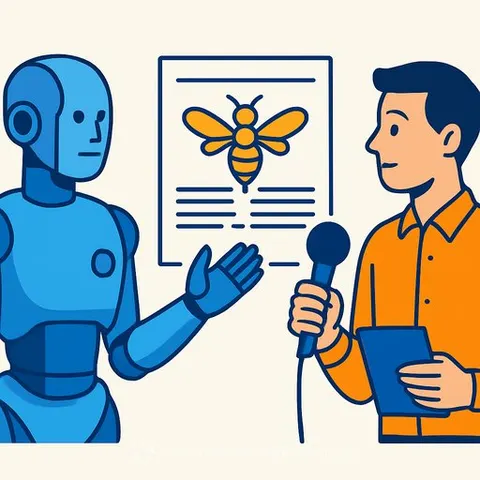
A Connecticut hyper-local newspaper has publicly declared it will not use artificial intelligence in its news reporting, rejecting the technology even as more newsrooms integrate it into daily workflows. The statement from The Newtown Bee, published July 30, 2026, comes at a time when writers across industries are confronting pressure to adopt Generative AI and LLM tools for drafting, research, and editing tasks.
"AI does not have residence within Bee Publishing Company. It is not welcome in any department within the historic building at 5 Church Hill Road where this hyper-local newspaper has been done by hand - and from the strong minds of those within - for just shy of 150 years," the editorial stated.
The editorial was prompted after a staff member was asked whether the paper uses AI. They answered "no," but the question sparked a broader reflection on what gets lost when algorithms replace the tedious work of reporting. One staff member recalled a conversation with a colleague at an online business news site who described using AI to compile research and write short releases. Those generated stories are vetted by humans to weed out hallucinations - misinformation the model treats as fact - but the original drafts still come from a large language model.
The case for doing the work yourself
The Bee's editorial argues that the tasks AI promises to handle - data mining, transcription, generating headlines and story outlines - are not bureaucratic busywork. They are the core skills of reporting. "No one goes into this job without knowing some of the work will be tedious," the editorial said. "You don't learn from CliffsNotes prepped by someone (or something) else. You learn from data you mine yourself."
The paper's staff members know their beats: zoning regulations, the Town Charter, local ordinances, and the people who shape them. That institutional knowledge cannot be outsourced. "Shortcuts can lead to long delays, and not taking the time to fully understand what is before us can lead to the long delay of making mistakes."
Ethical and environmental costs
The editorial also points to two unresolved problems with AI adoption. First, the legal status of training models on copyrighted material remains contested. The paper does not want to be on the wrong side of that argument. Second, the infrastructure required to run these models carries a heavy environmental footprint. Data centers supporting AI expansion consume millions of gallons of water daily and demand power loads rivaling small towns, straining local utility grids and increasing fossil fuel emissions, according to the World Resources Institute.
The paper pushed back against the idea that its stance is simply technophobia. The Newtown Bee was among the first newspapers in its state to maintain a regularly updated website. "It's not the technology itself we're opposed to," the editorial said. "And we will never rule out any change; the ability to be open minded and change one's mind given new information is key to learning."
Why this matters for writers
The editorial draws a line that many working writers are being asked to navigate right now. The promise of AI tools - speed, volume, relief from routine tasks - is real. But the cost is not just ethical or environmental. It is also developmental. The skills that make someone a strong writer or reporter are built through the repetition of exactly the tasks AI promises to automate. Offloading them early in a career means offloading the learning that comes with them. For writers weighing whether to integrate AI for Writers into their workflow, The Bee's position offers a clear counterargument: the tedious parts are not obstacles to the craft. They are the craft.